

Skip to content
View in the app

A better way to browse. Learn more.

3DWithUs

A full-screen app on your home screen with push notifications, badges and more.

To install this app on iOS and iPadOS
  1. Tap the Share icon in Safari
  2. Scroll the menu and tap Add to Home Screen.
  3. Tap Add in the top-right corner.
To install this app on Android
  1. Tap the 3-dot menu (⋮) in the top-right corner of the browser.
  2. Tap Add to Home screen or Install app.
  3. Confirm by tapping Install.

How 3D CAD Technology Is Shaping the Future of Custom Packaging

Featured Replies

In 2026, packaging design is about much more than creating an attractive box. It has become a key part of branding, product protection, and the overall customer experience. Businesses are looking for packaging that is visually appealing, functional, cost-effective, and environmentally responsible.

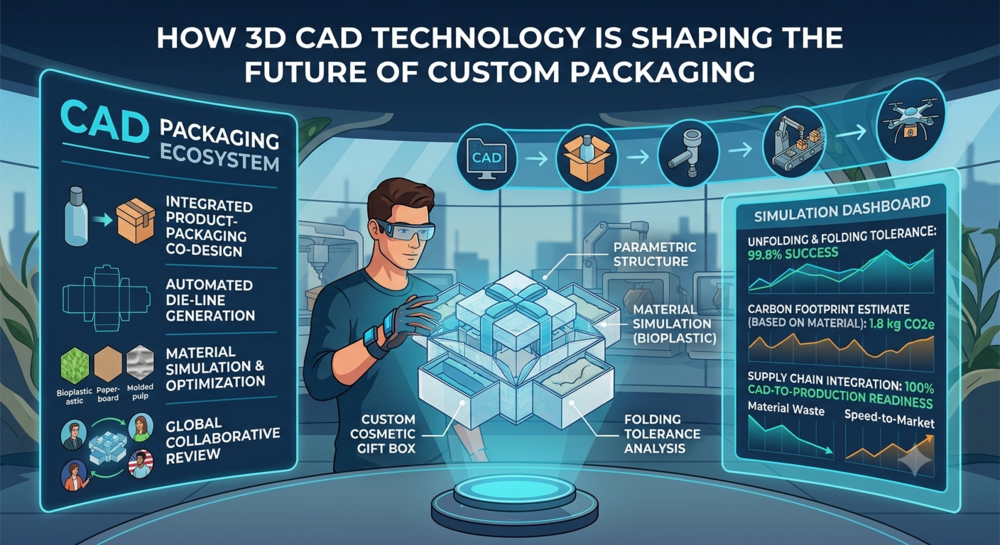
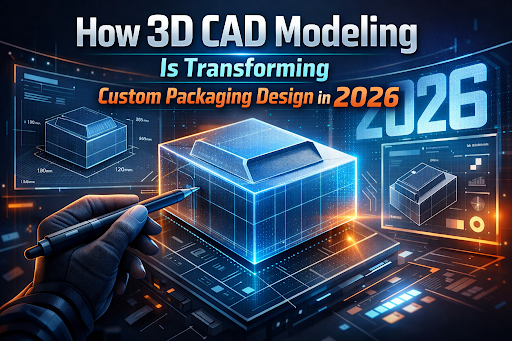
3D CAD modeling is helping make that possible. By allowing designers to create accurate digital packaging models before production begins, it speeds up development, reduces material waste, and improves design accuracy. From realistic 3D visualizations to faster prototyping, this technology enables brands to refine custom packaging with greater confidence while saving both time and production costs.

Factors Driving 3D CAD Adoption

The traditional ways of packaging are becoming less feasible as the manufacturing and consumer goods industries are facing many pressures:

  • Growth in e-commerce: The packages must be strong enough to endure during shipping and be capable of generating unforgettable unboxing experiences.

  • Sustainability expectations: Customers demand eco-friendly materials and the least amount of waste, something that requires brands to develop smarter.

  • Speed to market: The lifecycles of products are shorter, and hence there will be a need to have product prototyping and iteration.

  • Brand differentiation: The main characteristic of unique competitive markets is unique packaging design.

These forces render the business case of adopting CAD software that will facilitate higher and data-driven packaging development very robust.

Benefits of 3D CAD Modeling in Custom Packaging Design

The 3D CAD model enables designers and engineers to design very detailed computer representations of packaging with huge benefits compared to the usual 2D sketches or physical models.

Faster Prototyping with 3D CAD Modeling

Through digital prototyping, the teams would be able to simulate folding patterns, material behavior, and assembly processes before making a physical prototype. This reduces:

  • Material waste from numerous repetitions.

  • Delay in production due to design faults.

  • Costs relating to outsourced mock-ups.

An example of this is a beverage company that is creating custom bottles and cartons, which can simulate die-cuts, print finishes, and positioning inserts, all in CAD software and save weeks of prototype time, slicing down to days.

Creating Realistic Packaging Visualizations

State-of-the-art packaging visualization allows stakeholders such as the marketing team, up to clients, to view real images of the end product. Features include:

  • 3D, high-quality renderings with textures, colors, and finishes.

  • Simulations of light to evaluate visual effects.

  • Online presentation of interactive 360-degree models.

Such capabilities enhance the communication of the design and ensure that there is alignment among different departments, and costly misinterpretations are avoided.

Material Optimization Through 3D CAD Modeling

The 3D CAD modeling enables the packaging engineers to have precision that was not easy to attain before. Benefits include:

  • Proper dimensional modeling: Ensures a snug product insert fit and integrity.

  • Simulation of material: Determines the behavior of cardboard, plastic or sustainable substrates under stress.

  • Weight optimization: Minimizes shipping expenses and carbon footprint through minimizing extra material.

As an example, a cosmetics company that relies on unique packaging can shape the inside of the box to fit jars with a delicate design of glass jars and the smoothness on the outside- all can be done digitally before manufacturing.

Seamless Collaboration Across Teams and Locations

Remote and hybrid work will be the norm in numerous industries in 2026. Cloud-based CAD software enables:

  • Several stakeholders to collaborate on the same 3D in real-time.

  • Immediate feedback loops between the marketing teams and the designers

  • Smooth transition to manufacturers of precise specifications.

Use Cases Across Industries

The field of packaging is being revolutionized in various industries by 3D CAD modeling:

Food and Beverage

Prototyping of custom cartons, beverage carriers, and flexible packaging can be done virtually, and hygiene and shipping requirements are met.

Consumer Electronics

Complex boxes with custom inserts to fit delicate devices are designed to drop and be attractive, and are then produced.

Luxury Goods

The high-end brands are using digital prototyping to model finishes such as foil stamping, embossing, and textured finishes without having to physically make numerous expensive samples.

Advancing Pharmaceutical Packaging Design

Child-resistant closures, tamper-evident packaging, and informational inserts are also tested virtually to ascertain its accuracy and regulatory compliance.

Such examples indicate that custom packaging box design with the help of CAD is not confined to a particular industry- it is a universal tool that enhances efficiency, accuracy, and visual appeal.

Emerging Trends in 2026 Packaging Design

The companies are likely to see more innovation as the technology goes on developing:

  • AI-based CAD: Generative design algorithms propose the ideal ones in terms of product size and material limitations.

  • Augmented Reality (AR) implementation: Enables customers to see the packaging in real-life environments prior to manufacturing.

Practical Business Benefits

Implementing the use of 3D CAD modeling of custom packaging has tangible benefits:

  • Shortened time-to-market: Digital prototyping can speed decision-making.

  • Cost efficiency: Material waste is minimized, fewer physical prototypes, and improved shipping saves on costs.

  • Increased accuracy: Reduces manufacturing flaws and brand inconsistencies.

  • Enhanced teamwork: Cloud-based CAD solutions enhance internal and external communication.

  • Sustainability: The reduced number of prototypes and efficient designs will reduce the environmental footprint.

These advantages are directly translated into better ROI, increased customer satisfaction, and a better brand image.

Best CAD Software for Modern Packaging Design

Not all CAD tools are created equal. In selecting software to be used in the design of a package, consider:

  • Parametric modelling: It is necessary to enable rapid modification of a model without requiring the redesign of the whole model.

  • Library of materials: Ready-made cardboard, plastic, glass, and sustainable materials.

  • Image and graphics: Authentic textures and finishing of marketing presentation.

  • Collaboration features: Cloud access and version control by remote teams.

Top-of-the-market solutions in 2026 will consist of highly specialized packaging modules in mainstream CAD systems and purpose-specific packaging software that can be easily integrated into manufacturing processes.

Overcoming Adoption Challenges

The shift to using 3D CAD modeling can be overwhelming for companies that are used to old techniques of designing. Common hurdles include:

  • Designer/engineer learning curve.

  • Connection with the current ERP or PLM systems.

  • Initial software investment

By focusing on specific training, a gradual implementation, and pilot projects, it is possible to address these challenges and speed up the adoption and release the maximum possibilities of digital packaging design.

Conclusion

By 2026, 3D CAD modeling will have become an essential part of modern custom packaging design. It enables businesses to create accurate digital prototypes, reduce development time, minimize material waste, and improve collaboration throughout the design process. As brands continue to focus on sustainability, efficiency, and customer experience, CAD technology provides the flexibility needed to meet these evolving demands.

Companies that embrace 3D CAD modeling can bring products to market faster while producing packaging that is both functional and visually appealing. Whether serving retail, eCommerce, or specialty markets, digitally designed packaging helps brands stand out and adapt quickly to changing customer expectations.

For manufacturers, packaging designers, and product-based businesses, investing in 3D CAD modeling is more than a technology upgrade. It is a practical strategy for improving design accuracy, reducing costs, and building packaging solutions that remain competitive well into the future.


3D CAD Technology.png

Edited by gylehub
few mistake then i want to edit

Create an account or sign in to comment

Topics

Account

Navigation

Search

Search

Configure browser push notifications

Chrome (Android)
  1. Tap the lock icon next to the address bar.
  2. Tap Permissions → Notifications.
  3. Adjust your preference.
Chrome (Desktop)
  1. Click the padlock icon in the address bar.
  2. Select Site settings.
  3. Find Notifications and adjust your preference.