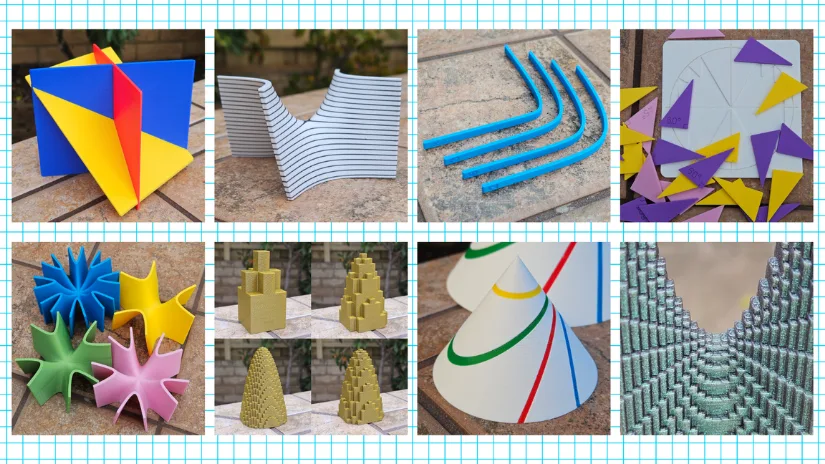
Mathematics is often taught through equations, sketches, and on-screen visuals, yet many students struggle to translate these representations into a true sense of three-dimensional form. Concepts such as curves, surfaces, and volumes can remain abstract when they exist only on paper or a screen, especially for students encountering them for the first time. Physical models offer a powerful way to bridge this gap by turning mathematical ideas into objects that can be held, examined, and explored.
Table of Contents
- Why 3D Printing Works for Math Education
- Teaching Background & Classroom Context
- 3D Printable Math Models Used in the Classroom
- Where to Download the Models
- Acknowledgements
- Final Thoughts
Why 3D Printing Works for Math Education
Mathematical topics that I have used and taught for years are easy for me to think about in real space. However, for my students learning concepts for the first time, it can be challenging to imagine how certain curves, surfaces, and shapes look and feel as objects off the page or screen. 3D printed models are an excellent vehicle for students to feel shapes and get their hands on three-dimensional figures in a way that traditional sketches and even more modern computer animations cannot.
In this article, I would like to share some of my recent models and talk about how they work mathematically, along with what I learned about 3D printing through making them.
Teaching Background & Classroom Context
I have been teaching high school mathematics for thirty years. Much of this time, I have been teaching Calculus II & III and Linear Algebra to advanced students for college credits. Currently, I am also teaching Integrated Math I Honors (a mix of Algebra I and Geometry) to 9th-grade students.
I talk to my department colleagues a lot about what they teach, and have been brainstorming things I could design and print to support other levels of math classes, too.
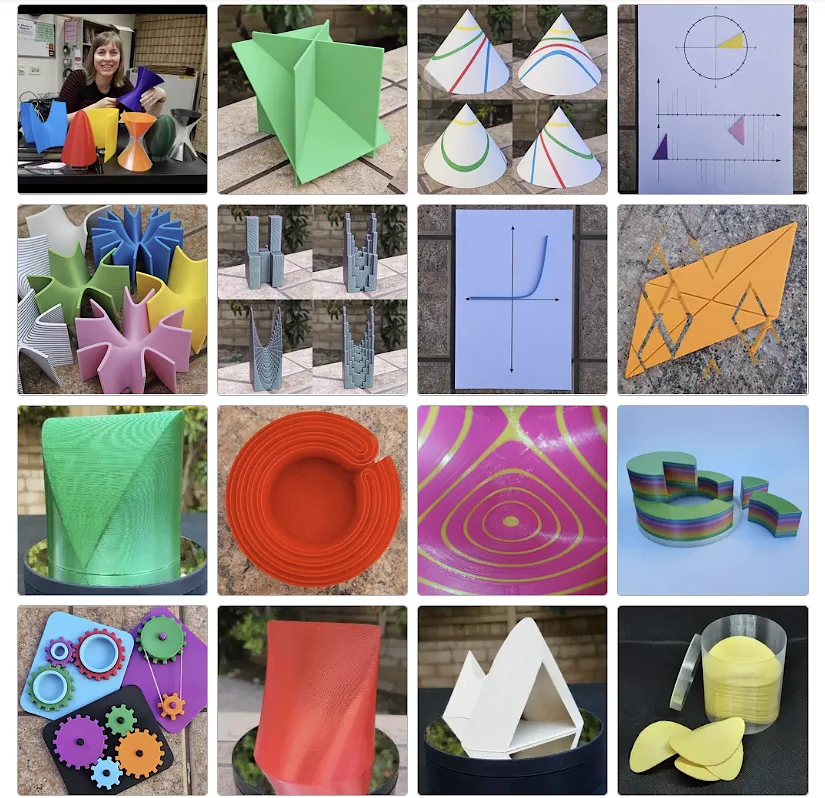
3D Printable Math Models Used in the Classroom
All of the models described in this article are available exclusively on Cults3D as part of the
Math Surfaces, Solids, etc. Collection.
3D Printing Setup & Notes: For these models, printing was done using a Prusa XL and/or Prusa MK4/S with PrusaSlicer. Some workflows or workarounds described may differ when using other printers or slicers, but many of the techniques and ideas are transferable.
While several of these models can be printed successfully on more affordable or smaller-format 3D printers, access to a larger build volume can be beneficial for producing oversized classroom demonstration models or printing class sets more efficiently.
Exponential Curves
– Math. The curriculum for my freshman students includes an introduction to exponential curves, even before we formally discuss parabolas. Early in the lessons, we look at the different directions the curve can go as an increasing or decreasing function, either away from or toward the asymptote.
This year, I thought it would be fun to get these functions into the students’ hands. I wanted to be sure the curves were mathematically accurate, so I used Wolfram Mathematica to generate the functions before importing them into Fusion, where I gave them depth and thickness, rounded corners, and a label for the base of the exponential function.
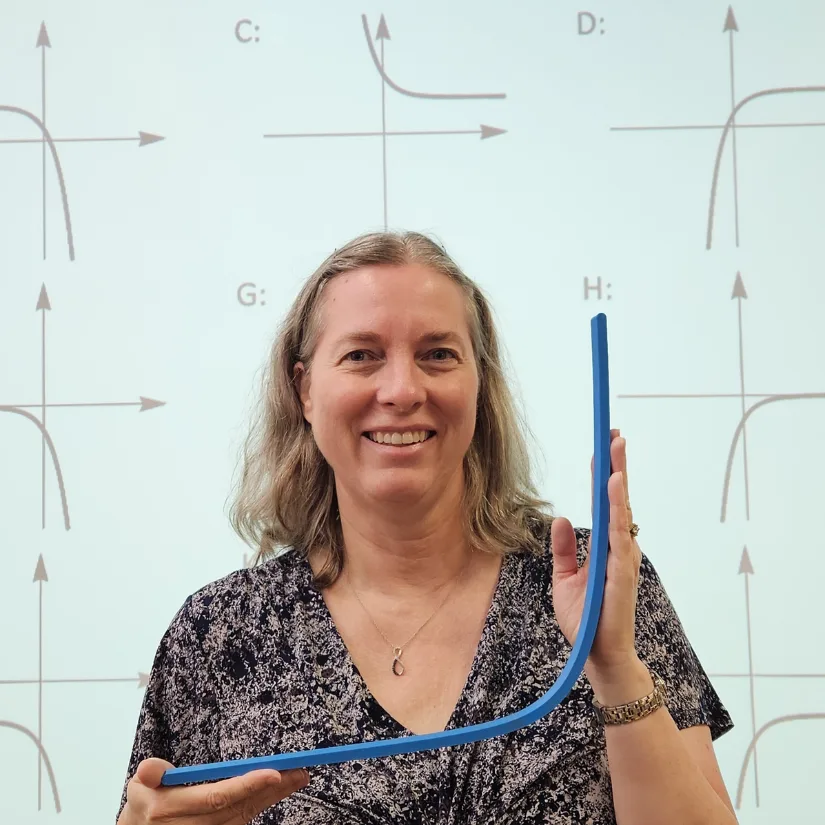
Print and Photo: Abby Brown
– 3D Printing Notes. Build STL files with multiple copies of the model. I knew I would be printing a lot of these curves. I needed a class set, and I was making class sets for other teachers, too. Exponential functions appear in many of our different courses.
While one model can be copied within the slicer, arranging many instances has limitations. With this shape, even with 0 mm spacing, using “fill bed with instances” only allowed for seven curves. In Fusion, I used the Rectangular Pattern tool to make 40 copies placed very close together. Exporting these as a single STL file (and a separate set of ten) allowed me to quickly set up prints of 50 curves on my MK4S printer.
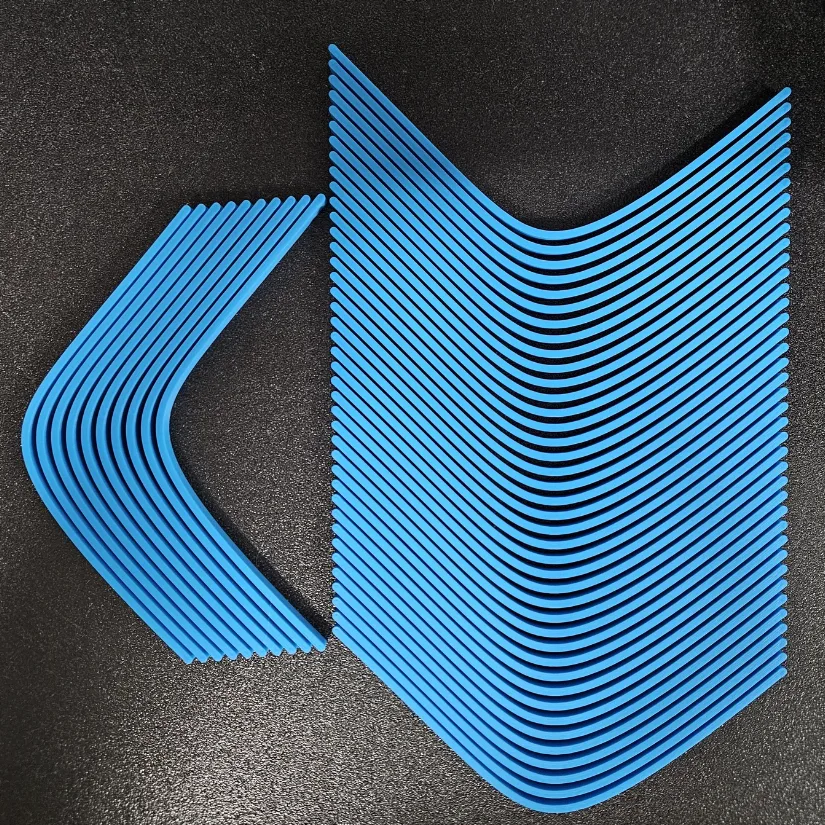
– Classroom Use. In class, these models were a hit. My students loved having them during the lesson. While teaching, I even changed my approach and emphasized predictions from equations much more than I typically do. It also became very clear that I needed a large model for working at the front of the classroom. I immediately scaled the model up 400% and printed it on my Prusa XL. I also made blank xy-axes on half sheets of paper for the class. This made it all work together even better. I printed the larger versions for other teachers as well. So fun!
Double Integrals
– Math. Ever since I started 3D printing, when I taught my lessons on double and triple integrals in Calculus III, I would say, “I should print that!” Once I experimented with it but never saw it through. This year was my year.
When we talk about calculating the volumes contained in a surface, we first consider approximations using rectangular prisms. These approximations get closer to the true volume when we use smaller blocks. Many years ago, I wrote code in Wolfram Mathematica to generate 3D graphics of solid circular paraboloids and hyperbolic paraboloids to illustrate this idea.
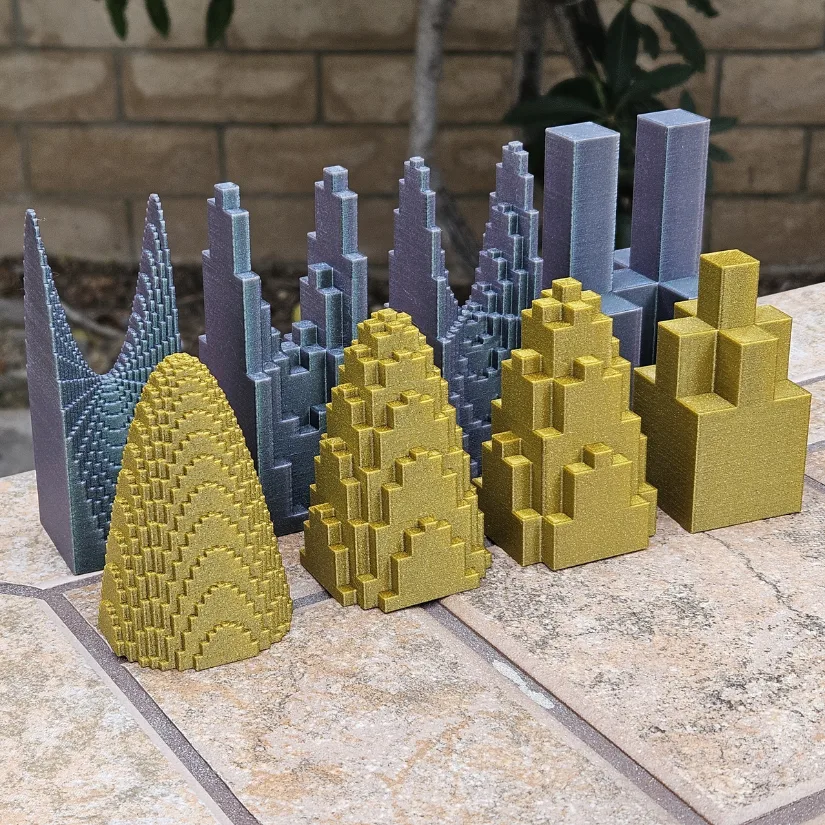
Print and Photo: Abby Brown
– 3D Printing Notes. Within Wolfram Mathematica, I was able to revisit and adapt that code to make solids that exported to STL files. It was particularly satisfying that my code was well set up for easily varying the number of blocks. With a few additional steps, I created a program that automatically generated and exported STL files for 30 paraboloid solids, each with a different number of prisms.
Once I brought them to school to share with my students, two things happened. First, I realized I needed a smooth version of each model to show the end-goal idea of the iterative process. The circular paraboloid was easy to print and beautiful. However, the hyperbolic paraboloid had challenges.
– Hot Tip. Print orientation matters! And don’t be afraid of supports. All of the other models printed very well standing up, but the thin tips on the hyperbolic paraboloid were going to have problems, as evident in the slicer preview.
I tried printing it on various sides, hoping that it wouldn’t need supports. I was able to print it, but eventually found that some support material helped a lot more. For so many years, I tried to avoid using supports, but 3D printing technology and slicers have improved so much that supports work better. Old habits die hard, and I have to remind myself that supports are okay when needed.
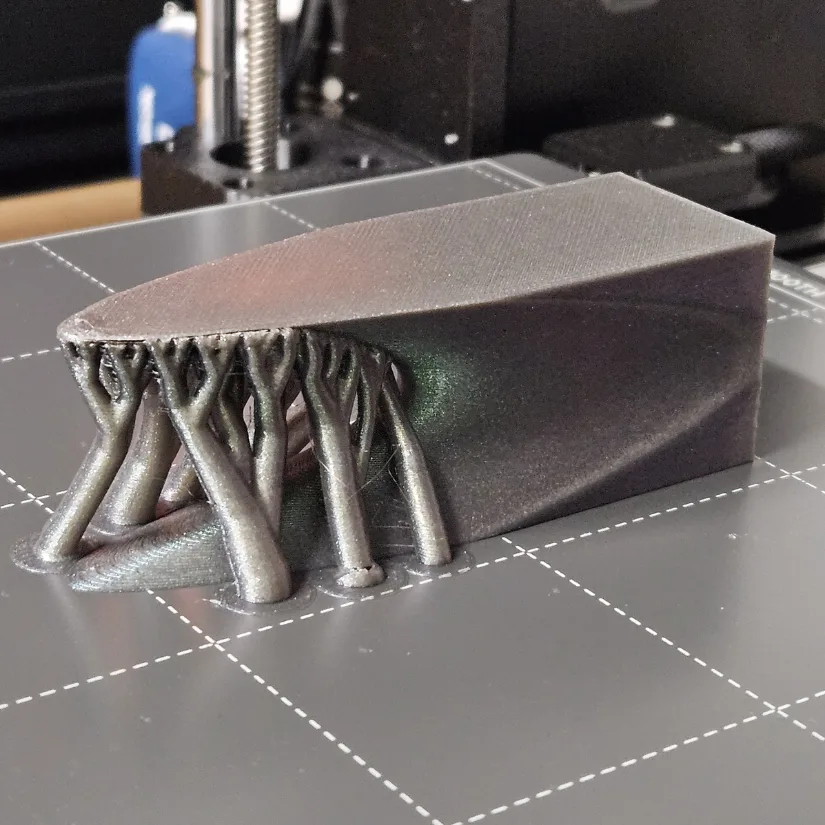
– Classroom Use. The second thing that happened was that even though these models were meant for my Calculus III students, my freshman students were quite interested in them, too. I had them on display near the classroom door, and they would handle them and ask questions at the end of class.
With the models alone, I was able to quickly explain the concept of integration as the limit of the approximations in just a few moments. What an amazing preview and foundation of mathematics to come for these younger students!
Saddle Surfaces
– Math. In my Calculus III class, we talk about various surfaces and special points on surfaces that are called “saddle points.” A basic saddle surface is fundamentally the shape of a saddle that a person would sit in when riding a horse. With some changes to the function, another saddle has a spot for a third leg. This is often called a “monkey saddle.” As I tell my students, “It is not the saddle you would put on a monkey, but the saddle the monkey would sit in.” A monkey’s tail would go through the third position.
There is also a “dog saddle” and a “starfish saddle” for four and five, respectively. In class, I have an animation that I created in Wolfram Mathematica that varies one parameter to change a basic 2-saddle to a 3-saddle and then a 4-saddle, and so on, all the way through to an 8-saddle. Of course, this leads the class to call it an “octopus saddle.”
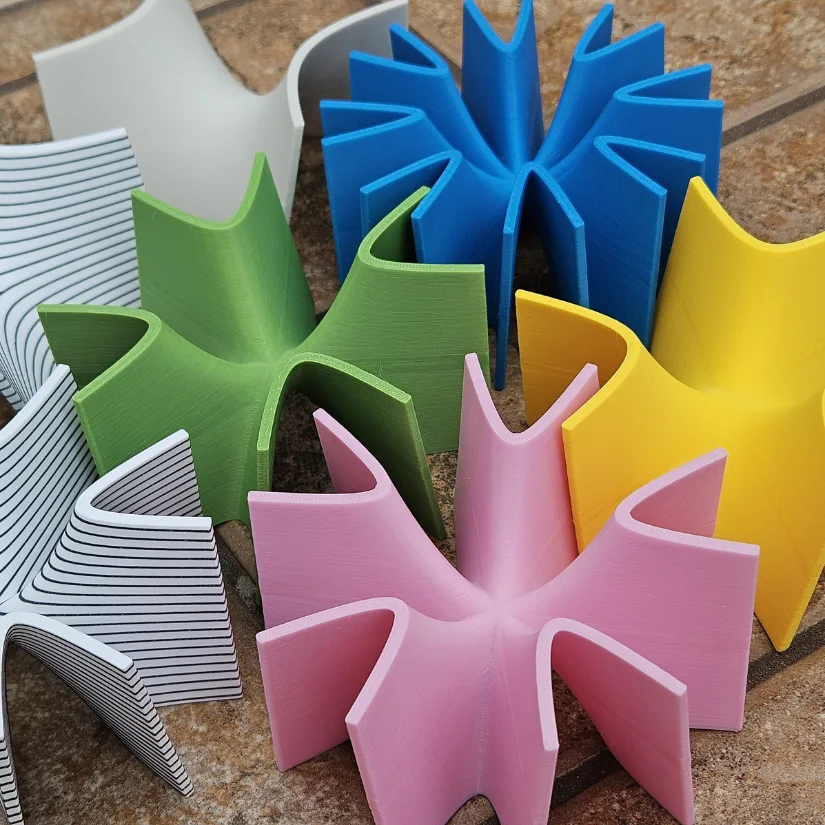
Print and Photo: Abby Brown
– 3D Printing Notes. My students have asked me to print an “octopus saddle,” and this year I finally did. I was able to adapt the code for my animation to export STL files as thick surfaces. Once I had the models, I scaled them so the 8-saddle would perfectly fit the cute articulated mini-octopus by McGybeer. I also wanted to use the saddle surfaces to experiment again with printing contour lines as level sets in a surface. I had done this earlier in my 3D printing journey, but now I have better machines and more experience.
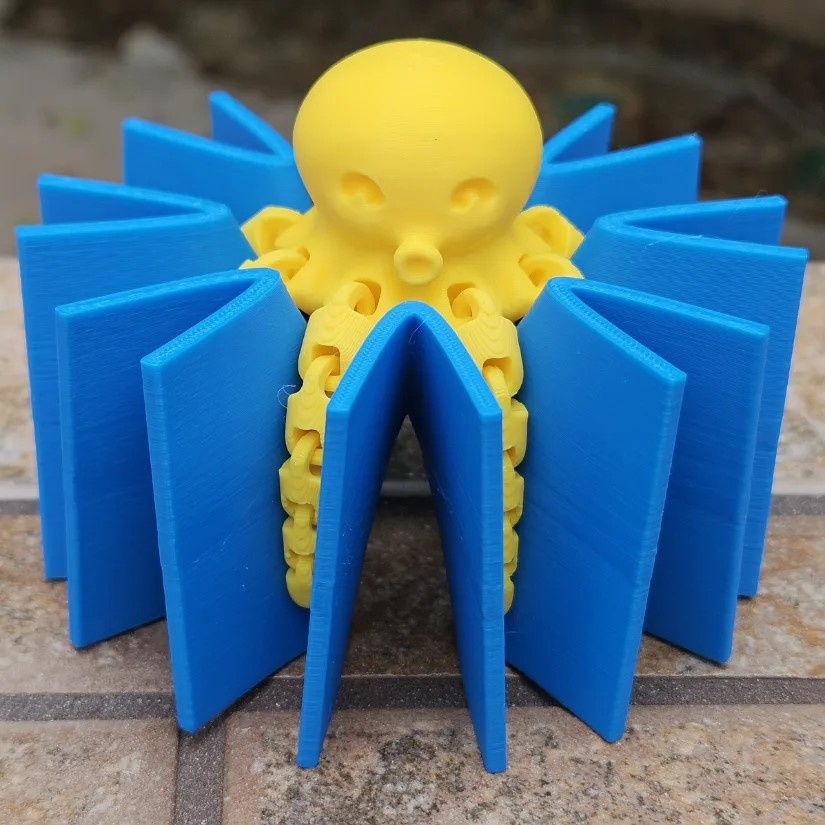
– Hot Tip. Use another model to set locations for color changes. I have to credit Dom Dominici for the foundation of this idea. In Fusion, I made a stack of thin planes with the spacing and thickness I desired. This was exported as its own STL file. In PrusaSlicer, once I imported the saddle surface, I used “Add Modifier” to load the stacked-plane STL and set a different extruder for that model. It works wonderfully, and I look forward to using my “contour creator” STL files with other surfaces in the future.
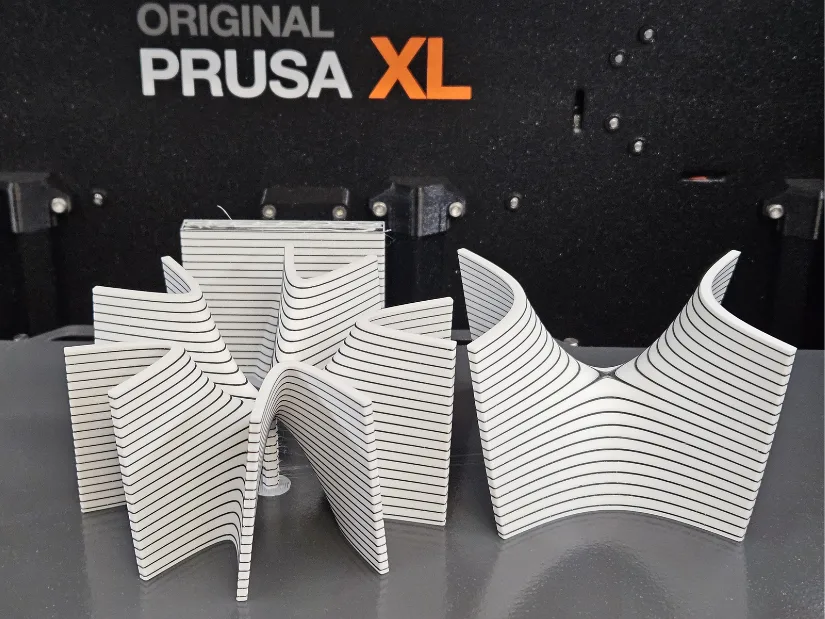
– Classroom Use. The saddle surfaces have become a memorable part of my Calculus III lessons. The physical models help students connect the idea of saddle points and changing curvature to something they can see and touch, rather than just a formula or animation.
Unit Circle Triangles & Tray
– Math. I have never explicitly taught trigonometry. It is either beyond the scope of my classes with younger students, or my Calculus students already know it when they enter my class. However, I have always enjoyed trigonometry concepts, and it is a very big topic for many other teachers in my department. I wanted to use 3D printing to make something to support the important topic of the unit circle.
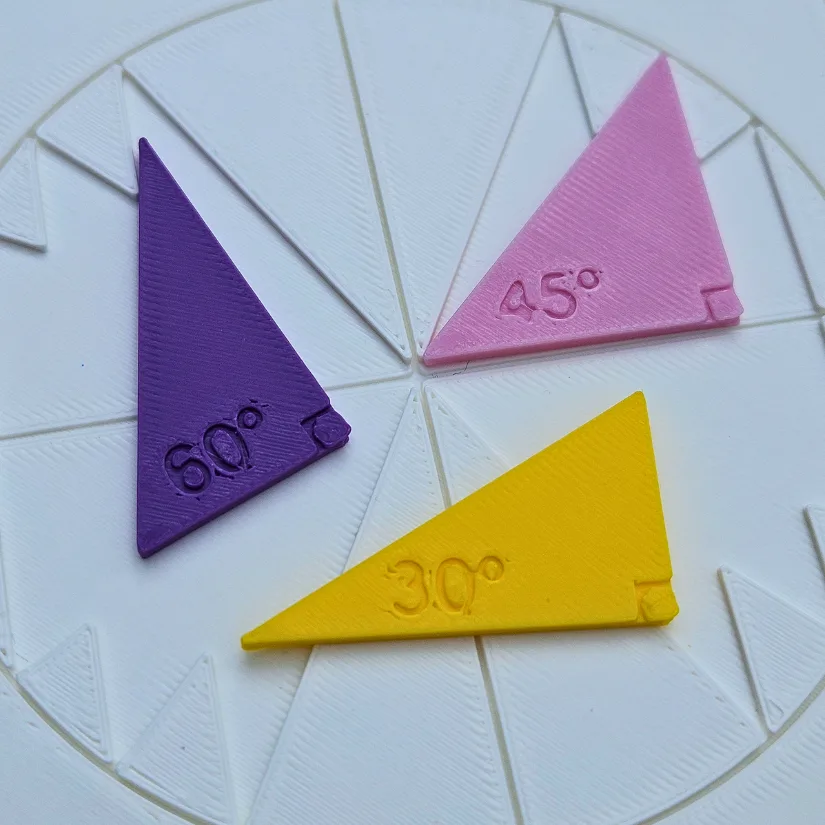
Print and Photo: Abby Brown
– 3D Printing Notes. Overall, these were simple models to make, but for the first time I designed and posted worksheets to go along with the models. When printed at 100% scale, the models and the paper documents work together to help illustrate characteristics of special values on the unit circle.
– Hot Tip. Merge a couple of models for more efficient arrangements. When printing so many triangles, simply auto-arranging in the slicer left a lot of extra space. I wanted to cover the build plate better.
To do this in the slicer, I took a single triangle and made a copy of it. I rotated the copy 180 degrees and moved it close to the original so the hypotenuse of each triangle nearly touched. In the slicer, I selected both models and then “merged” them together. This created a single object with two triangles. Now I could “fill bed with instances” or set the number of triangle pairs I wanted, and auto-arrange worked beautifully.
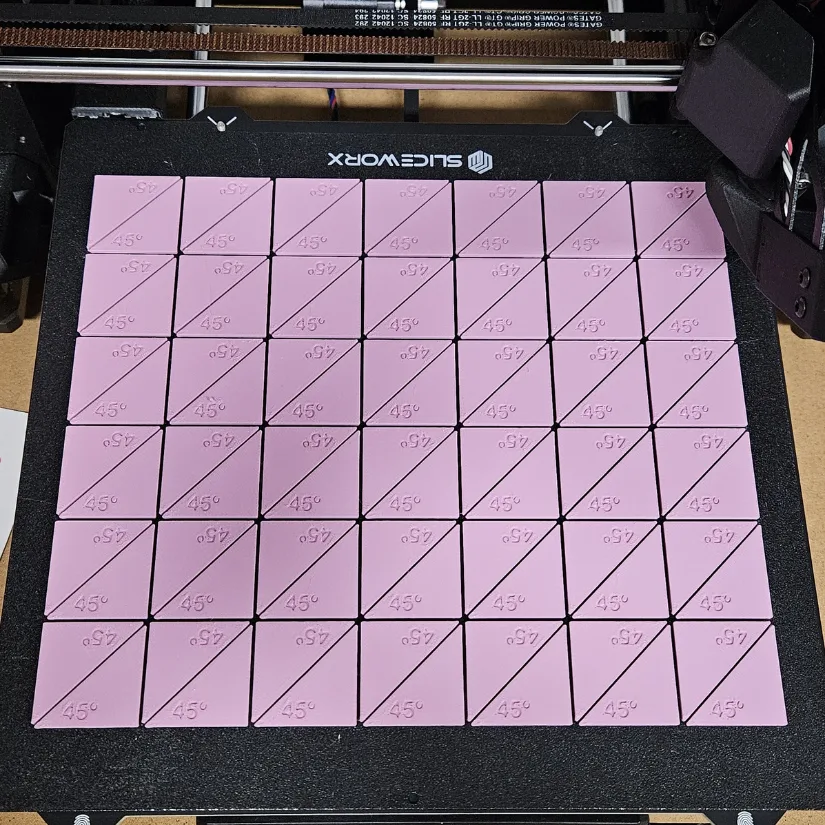
– Classroom Use. With a pencil, the models can be used to develop the curves for the sine and cosine functions on coordinate axes. Again, I found myself making multiple class sets of models. My colleagues were excited to receive their triangles, and some asked for the trays too. It was fun to see them try a new approach to teaching and reviewing trigonometry.
Conic Sections Cone
– Math. Students are taught that hyperbolas, parabolas, ellipses, and circles are “conic sections,” or “conics.” However, it is not always well illustrated or tangible for them. There are many 3D printable models that break up a cone into slices that can be taken apart to see the conic section curves. However, I wanted to make a single model, with both nappes of the cone, to show the curves embedded directly in the cone.
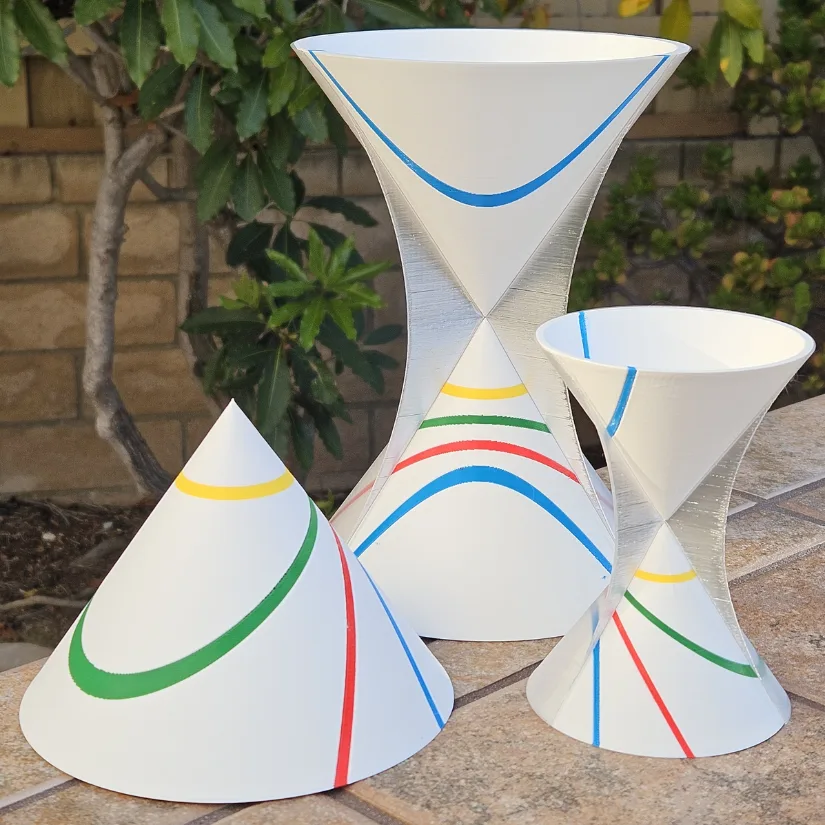
Print and Photo: Abby Brown
– 3D Printing Notes. I also wanted to take advantage of the five tools on my Prusa XL. Early in my 3D printing journey, I had designed and printed a two-part cone that sits in a separate “cone holder” model, so I knew how to build it. What surprised me was how I ended up assigning the colors in the slicer for printing.
– Hot Tip. Multimaterial “painting” in the slicer may work better than assigning extruders to models.
In my early days of 3D printing, I assigned colors by separating each color into its own model and process. With newer printers and slicers, “painting” models is now an option, but I tended to avoid it because I was comfortable breaking models apart.
While working on an earlier striped vase, I noticed that assigning extruders produced rough-looking curves, while painting the model resulted in cleaner results. The slicer was able to intelligently thicken features where needed for reliable printing while preserving the intended surface appearance. When I noticed similar roughness on the Conic Sections Cone, I applied the painting technique again, and it worked much better.
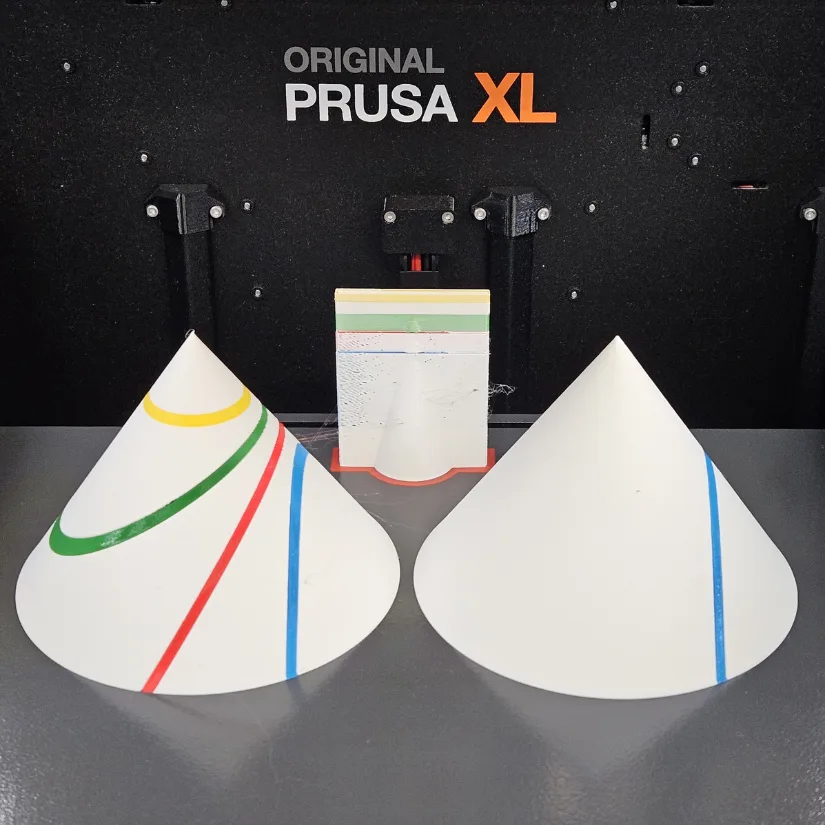
– Classroom Use. The Conic Sections Cone has become a dramatic addition to my classroom collection. It allows students to see, in a single object, how different conic sections emerge from the same geometric structure. I will be making more of these cones for other teachers soon.
Three Intersecting Planes
– Math. Part of the beauty of making a model of three intersecting planes is that it is useful for lessons with my Integrated Math I classes as well as my Linear Algebra classes. Students easily understand the intersection of two lines, but rarely see the intersection of planes until higher-level mathematics.
A model such as this gets the idea into their hands to explore and consider in a different way. My daughter in middle school is also learning about systems of equations, and she is solving three-variable systems in her homework as I type this.
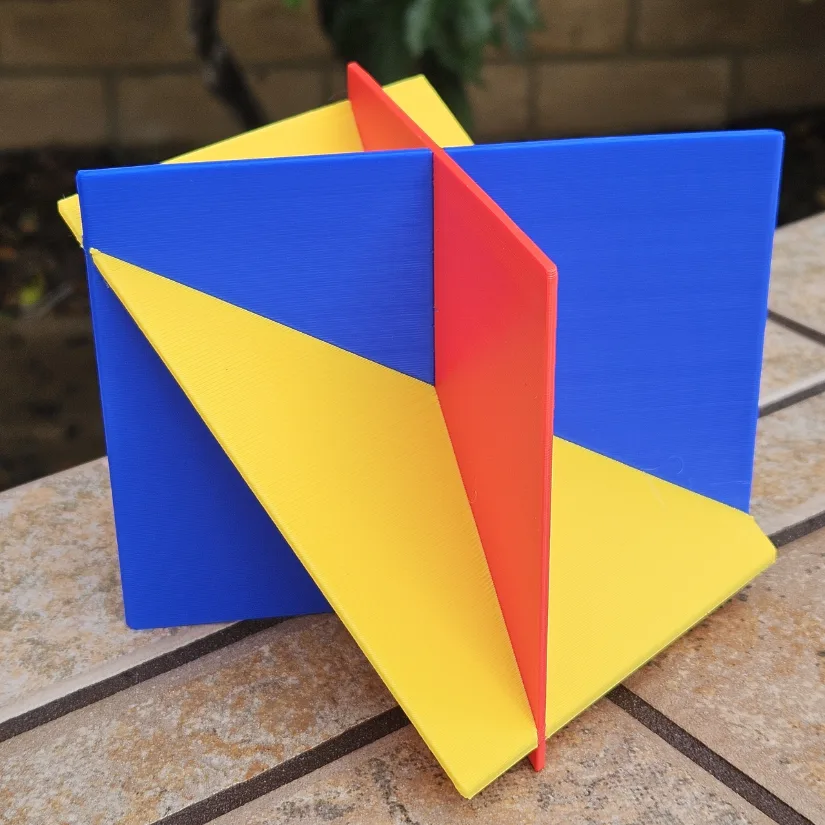
– 3D Printing Notes. It was easy to design a model with three planes, but I wanted something that would print relatively easily without having the planes orthogonal (perpendicular) to each other and without requiring excessive support.
I adjusted the angle for the yellow plane and tested it in the slicer a few times to make sure it would mostly print well. However, the way I chose to cut it meant that it would still need some support to print the lower part of the yellow plane.
– Hot Tip. Create another model for more control of colors. I have not yet learned to fully take advantage of multimaterial supports, and I didn’t want to experiment on this print. However, I was frustrated that the support contact layer kept printing in red or blue instead of yellow. To solve this, I created a small “helper block” model to force yellow filament to be used at the layer where the supports ended. The block consisted of a red base and a short yellow cylinder at the top, carefully sized so that one layer of yellow would become the top layer of the support. This is a trick I will likely use again in future prints. I love the bold colors for this print and may be tempted to try a larger version at some point.
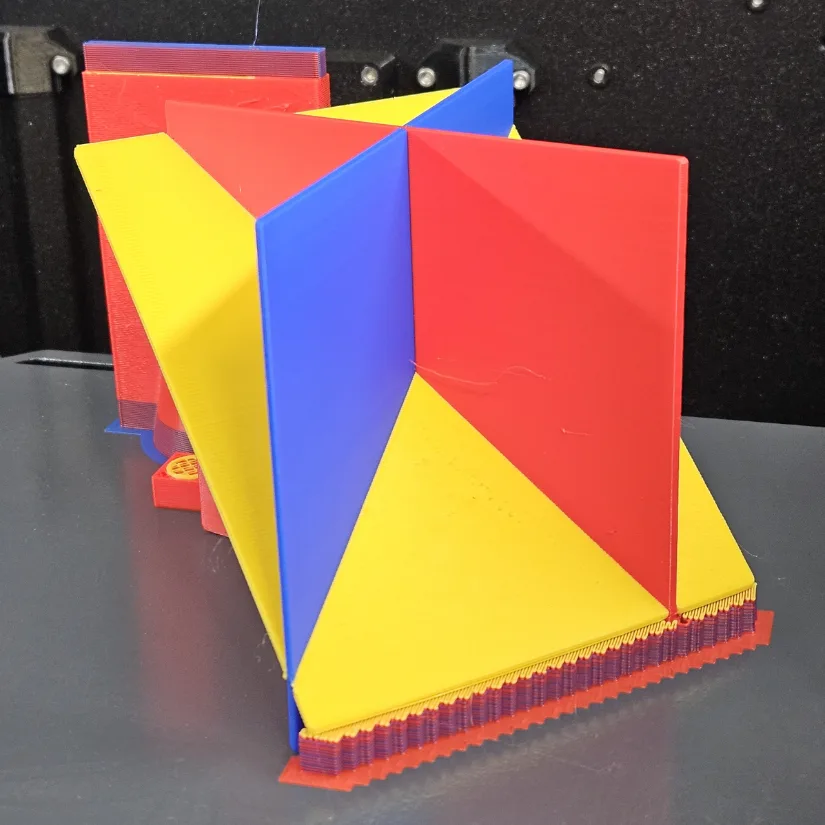
– Classroom Use. The three intersecting planes model has proven to be a powerful visual aid. It helps students move beyond symbolic systems of equations and see how solutions correspond to intersections in three-dimensional space.
Where to Download the 3D Printable Math Models
All of the 3D printable math models shown in this article are available as a curated collection by Abby Brown on Cults3D.
The collection includes all six model types discussed above and is designed for educators who want ready-to-print files that work well in real classroom settings.
You can find the full collection here:
Math Surfaces, Solids, etc. – 3D Printable Models by Abby Brown
This collection may continue to grow over time as new models are developed. Readers are welcome to bookmark this page or revisit the collection in the future to explore additional 3D printable math models.
Acknowledgements
I would like to sincerely thank the TPHS Foundation, whose Fall 2025 grant provided the 3D printing filament used to create several of the models shown in this article. Their support made it possible to experiment, iterate, and produce full classroom sets without limitations, directly helping bring these mathematical ideas into students’ hands.
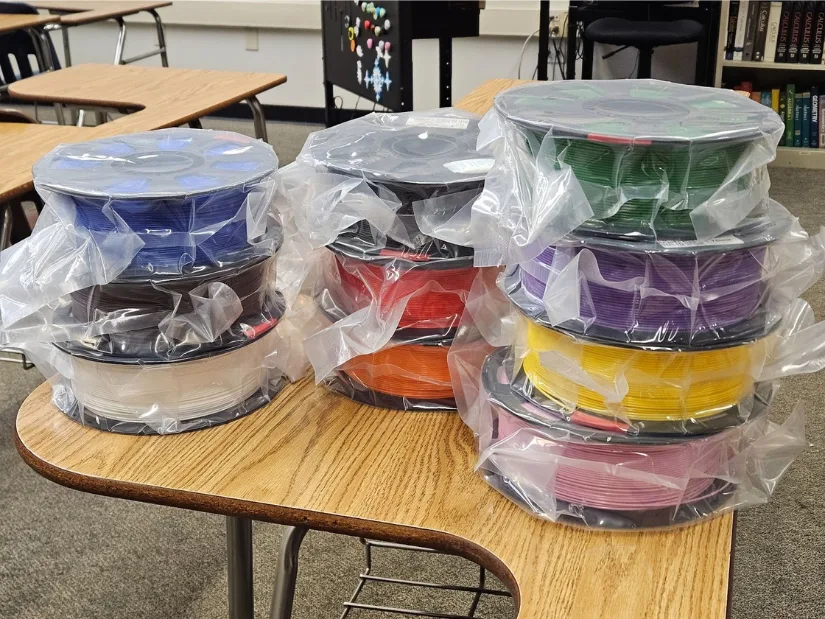
Support like this plays an important role in helping educators explore new tools and approaches, and I am very grateful for the opportunity to use 3D printing to enhance learning in meaningful ways.
Final Thoughts
Creating physical models for abstract mathematical ideas has changed the way my students engage with the material. Concepts that once felt distant or symbolic become tangible when students can hold, rotate, and explore them in their hands.
3D printing has given me the freedom to design exactly the teaching tools I want, rather than adapting my lessons to whatever materials happen to be available. From introductory classes to advanced topics, these models have opened up new conversations and a deeper understanding across a wide range of students. I hope these examples inspire other educators to experiment with making their own models or to explore how digital design and 3D printing can support meaningful learning in mathematics and beyond.
Have questions? Feel free to ask in the comment section below.
For a wider discussion or to share educational prints, join us in the forum: