
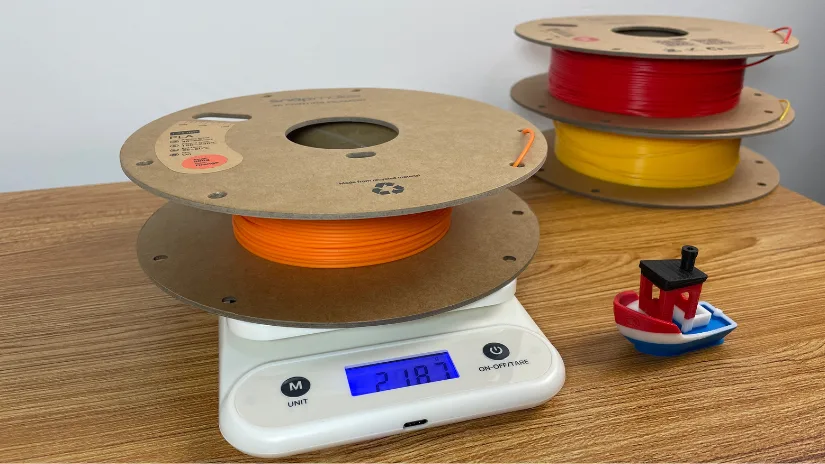
Not sure if your partially used spool has enough filament left for your next 3D print? This simple Filament Remaining Calculator helps estimate how many grams and meters of filament remain on your spool based on total spool weight, empty spool weight, material type, and filament diameter.
Use it as a quick planning tool before long prints and reduce the risk of running out of filament mid-job.
Table of Contents (Jump to a Section)
Filament Remaining Calculator
Filament Remaining Calculator
Estimate how much filament is left on your spool.
How It Works
The calculator estimates remaining filament by subtracting the empty spool weight from the total spool weight. It then uses filament diameter and material density to estimate how many meters of filament remain.
This is an estimate, not an exact measurement, but it is often accurate enough to help plan your next print.
How to Find Empty Filament Spool Weight
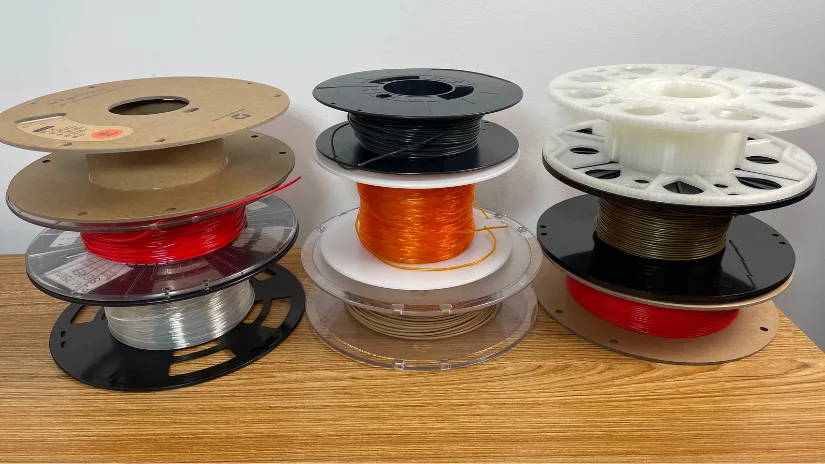
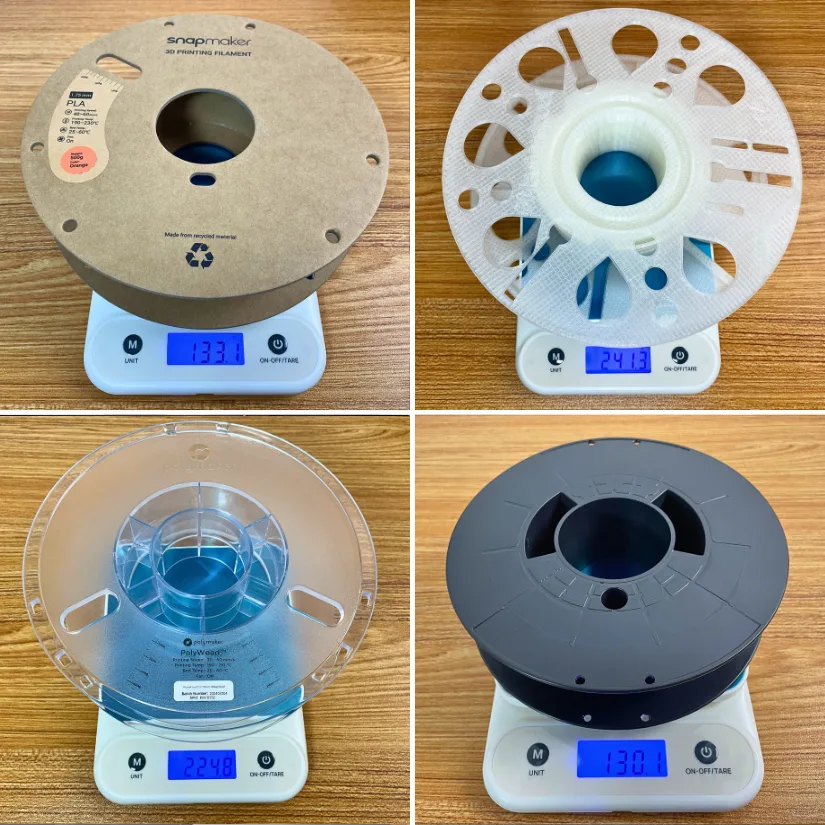
To calculate how much filament remains on a spool, you first need to know the weight of the empty spool itself. This is one of the biggest variables in any filament remaining calculator, as spool weights differ between manufacturers, spool sizes, and materials.
For example, a cardboard spool used by eco-focused brands may weigh significantly less than a reusable plastic spool. Some refill systems can also use heavier reusable spools that may affect your calculation if not accounted for correctly.
Here are the easiest ways to find your empty spool weight:
If you do not already have kitchen scales at home, a basic digital scale can make weighing filament spools much easier. Most 1kg filament spools fit comfortably on standard kitchen scales, and they can also be useful for resin, mixing materials, and general workshop tasks.
Recommended: Digital Kitchen 5kg/0.1g Scale on Amazon
- Check the filament label or packaging – some brands list empty spool weight
- Visit the manufacturer’s website or product page
- Search Google for “[Brand Name] empty spool weight” — Google AI may surface quick answers, but verify the result if possible
- Weigh an empty spool yourself using kitchen scales
- Use average spool weight estimates if no exact data is available
If you regularly print with the same brand, it may be worth saving empty spool weights in a simple note for future reference.
Typical Empty Filament Spool Weight Examples
©3DWithUs – Photo: Max Funkner
These are rough averages based on common 1kg filament spools:
- Cardboard spool: approximately 120g–250g
- Plastic spool: approximately 200g–300g
- Reusable refill spool systems: approximately 250g–500g+
- Mini spools: vary heavily depending on brand and filament amount
To provide examples, we weighed several empty filament spool types used in our workshop. Your results may vary by brand, but these examples show how dramatically spool weights can differ.
©3DWithUs – Photo: Max Funkner
Community contribution: Big thanks to Scuk for starting a catalog of more than 200 weighed empty filament spools on Printables. It’s a very helpful resource if you need a specific brand or spool type.
You can use Ctrl + F to quickly search the list for your spool:
Empty Spool Weight Catalog on Printables
What to Print with a Nearly Empty Filament Spool
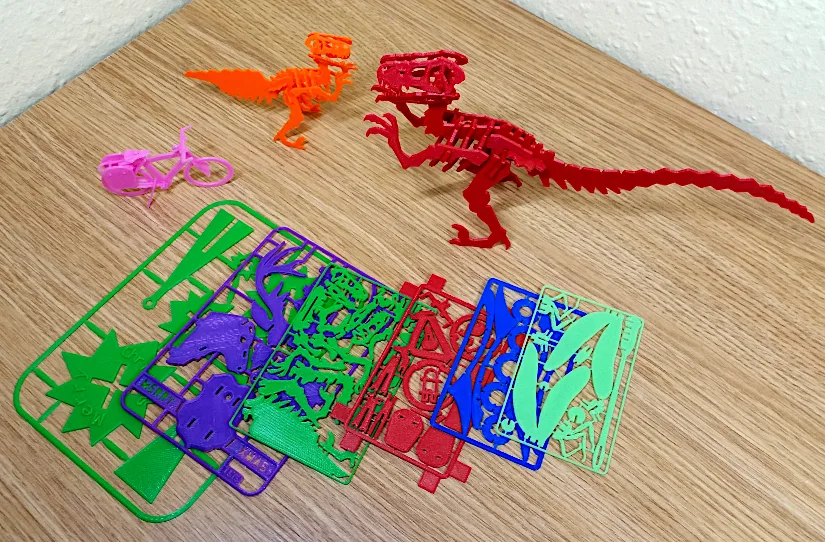
As mentioned earlier, lightweight prints are a great way to use up leftover filament. Models like Flexi Rex helped popularize the wave of articulated prints years ago, and today there are countless similar flexi models available across MakerWorld, Printables, and other STL platforms. Many of these designs require relatively small amounts of filament and are ideal when you are trying to finish a partially used spool.
©3DWithUs – Print and Photo: Max Funkner
Kit card models can be an even better option. These flat-packed designs are often extremely lightweight, quick to print, and easy to gift. Some are slim enough to fit inside a standard envelope, making them popular for events, giveaways, and seasonal gifts.
If you are looking for more ideas, explore our seasonal 3D printing guides in the 3D print ideas area, where we regularly feature lightweight gift ideas, decorations, and quick projects that work well with leftover filament.
Filament Connector
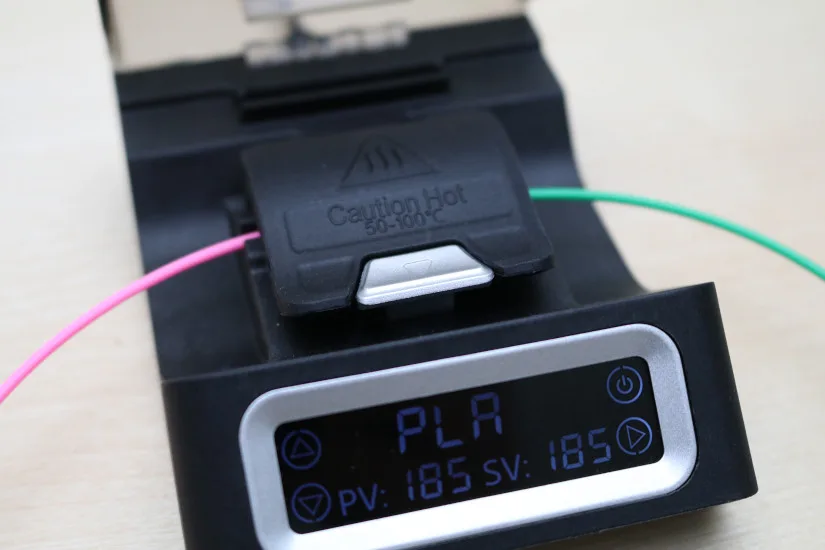
©3DWithUs – Photo: Andrew Sink
If your spool is running very low but still has usable filament left, filament splicing tools on Amazon can help combine leftover pieces instead of wasting them. This can be particularly useful for smaller prints, test models, or finishing nearly empty spools. We covered this topic in more detail in our Filament Connector: Filament Splicing Made Easy guide.
Common Mistakes When Estimating Remaining Filament
The most common mistake is forgetting to subtract the empty spool weight from the total spool weight. This can instantly throw off your estimate by 150–300g, depending on the brand and spool material. Another frequent issue is selecting the wrong filament diameter. While most hobby printers use 1.75mm filament, some machines still rely on 2.85mm material, and choosing the wrong option can significantly affect the estimated filament length.
It is also worth remembering that not all filament brands use identical spool designs. Cardboard spools, reusable refill systems, and heavier plastic reels can all produce different results. Even if your calculation looks accurate, avoid starting very large or multi-day prints with very little filament left. Your slicer remains the best source for exact filament usage estimates, so use this calculator as a planning tool rather than a guarantee.
If you are close to running out, consider switching to a fresh spool or enabling filament runout sensors if your printer supports them. It is far better to swap filament early than lose a long print near completion.
Why Filament Type Affects Your Results
Different filament materials have different densities, which means the same spool weight can translate into different filament lengths. This is why our calculator asks you to select a material type before generating an estimate. A 200g remainder of PLA may not provide the exact same number of printable meters as 200g of ABS, TPU, PETG, or Nylon.
PLA and PETG are among the most commonly used materials for everyday prints, while TPU is often used for flexible parts and Nylon is typically chosen for more demanding functional applications. ABS remains popular for certain workshop and engineering projects. Because each material behaves differently in both weight and print settings, your slicer may still show slightly different filament usage depending on layer height, infill percentage, wall thickness, and support structures.
For the most accurate planning, use this calculator as a quick estimate and then confirm the final filament requirement inside your slicer before starting longer prints.
Related Tools and Guides
- 3D Print Cost Calculator
- 3D Printer Electricity Cost Calculator
- Best Filament Dryers and Storage Solutions
- Filament Connector: Filament Splicing Made Easy
- Best Budget 3D Printers
Have questions? Feel free to ask in the comment section below.
Want to share spool weights or calculator suggestions? Join us in the forum:
Final Thoughts
A simple kitchen scale and this calculator can help reduce wasted prints and make better use of partially used filament spools. It is especially useful when managing multiple open spools or preparing for larger projects.









Useful spool-weight workflow. One extra check I use before long prints is to keep two margins separate: measurement error / empty-spool uncertainty, and the planned safety margin. Remaining filament = total spool weight – empty spool weight