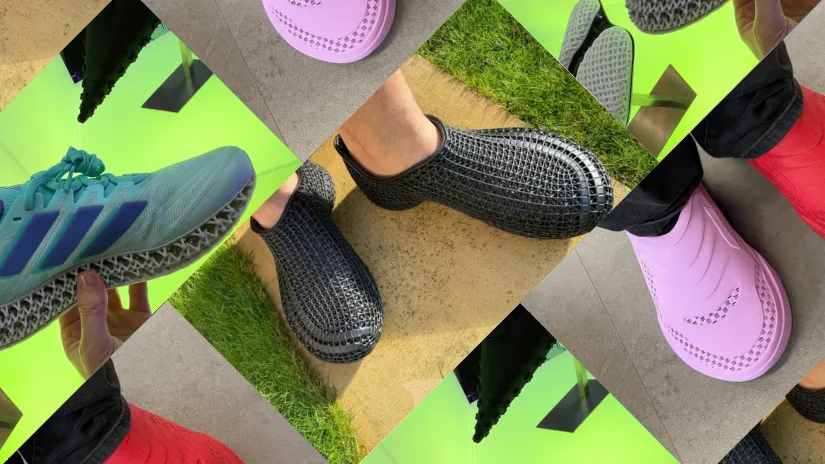
3D printed shoes are no longer just experimental prototypes. They are becoming wearable products that people can actually experience in everyday conditions. From lattice midsoles used by global sports brands to fully 3D printed footwear produced without traditional tooling, additive manufacturing is steadily reshaping how shoes are designed, manufactured, and customized.
I recently had the opportunity to test multiple 3D printed shoes at a major international trade show, including fully printed lattice designs worn for extended hours on hard exhibition floors. Beyond simply trying them on, I stress-tested comfort, breathability, durability, and practicality while also speaking directly with industry leaders developing the next generation of 3D printed footwear.
This guide breaks down what 3D printed shoes actually are, how lattice structures work, which brands are leading the space, and whether fully printed footwear delivers real advantages over hybrid designs. If you are wondering whether 3D printed shoes are comfortable, durable, sustainable, or even possible to print at home, this in-depth overview will give you clear, experience-based answers.
Table of Contents (Jump to a Section)
Why 3D Printed Shoes Matter Now
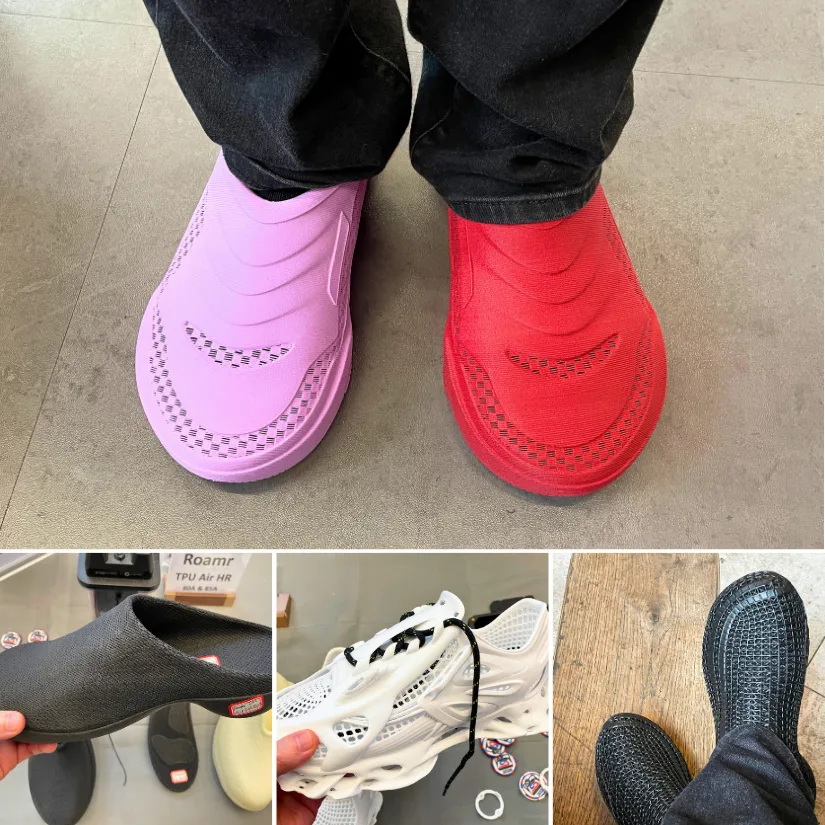
3D printed shoes have moved beyond experimental concept pieces and into real products that people can actually wear. What started as futuristic lattice prototypes is now evolving into fully printed footwear systems that challenge traditional manufacturing, materials, and even brand models. The conversation is no longer about whether 3D printing can produce shoes, but whether it can improve how shoes are designed, customized, and distributed.
©3DWithUs – Photo: Max Funkner
With major brands exploring lattice midsoles and emerging companies producing fully 3D printed structures, the footwear industry is quietly entering a digital manufacturing shift. For makers, designers, and technology enthusiasts, this is more than a trend. It represents a potential rethinking of production, ownership, and personalization in one of the world’s largest consumer product categories.
What Are 3D Printed Shoes?
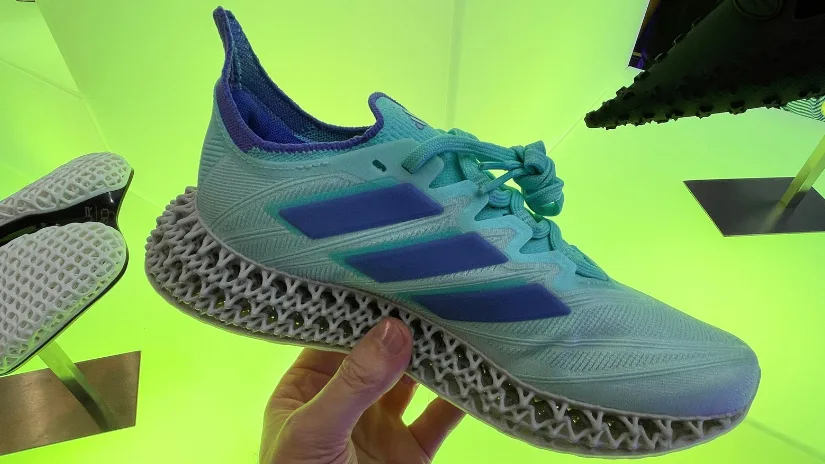
3D printed shoes fall into two main categories. One approach uses 3D printing to produce a lattice midsole while the rest of the shoe, including the upper, remains traditionally manufactured. These lattice structures are designed to provide tuned cushioning, energy return, and visual impact, but they represent a hybrid model rather than a fully printed product.
©3DWithUs – Photo: Max Funkner
Fully 3D printed shoes take a different approach by producing the entire structure as a single printed form. Instead of combining printed and conventional components, the whole shoe is manufactured through additive processes. This removes tooling and assembly steps and opens the door to digital customization, but it also introduces new questions around comfort, durability, and scalability.
The Technology Behind 3D Printed Footwear
At the core of most 3D printed footwear is lattice geometry. Instead of solid foam, these shoes use engineered cellular structures that can be tuned for cushioning, flexibility, and energy return. By adjusting the size, density, and orientation of the lattice, designers can control stiffness in specific zones of the sole, directly influencing comfort and durability.
Materials play an equally important role. Most 3D printed shoes rely on elastomer-based materials such as TPU or flexible polymers that combine resilience with fatigue resistance. Industrial systems often use advanced nylons or performance elastomers, while makers experimenting at home typically rely on flexible TPU filaments. The material choice determines not only comfort but also lifespan and structural integrity.
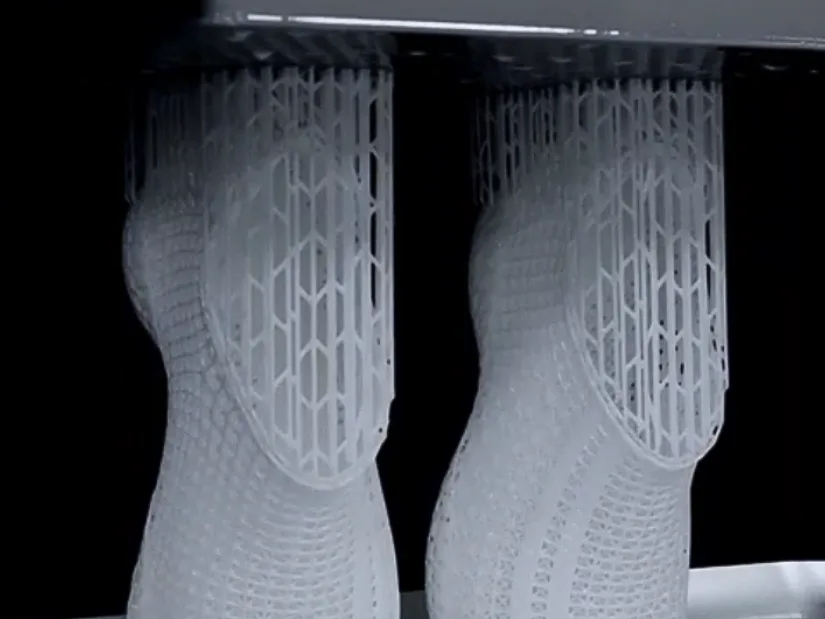
Photo: PollyFab
From a manufacturing perspective, selective laser sintering has become the dominant process for functional footwear due to its ability to produce strong, flexible lattice structures without support material. Resin-based systems can achieve fine detail and consistent elasticity, while FDM printing remains more accessible but limited in long-term wear performance. Hybrid models combine printed components with traditional uppers, bridging digital and conventional production.
Beyond hardware, 3D printed footwear introduces a different design workflow. Digital modeling, foot scanning, and iterative prototyping allow for rapid refinement without tooling changes. While true mass personalization is still evolving, the shift toward scan-to-production pipelines signals a future where fit and structure can be digitally optimized before a shoe is ever manufactured.
Major Brands & Players in 3D Printed Shoes
Zellerfeld
Zellerfeld represents one of the boldest interpretations of fully 3D printed footwear. Unlike hybrid shoes that combine traditional uppers with printed midsoles, Zellerfeld produces shoes as a single 3D printed structure, removing conventional tooling, glue, and multi-material assembly from the equation.
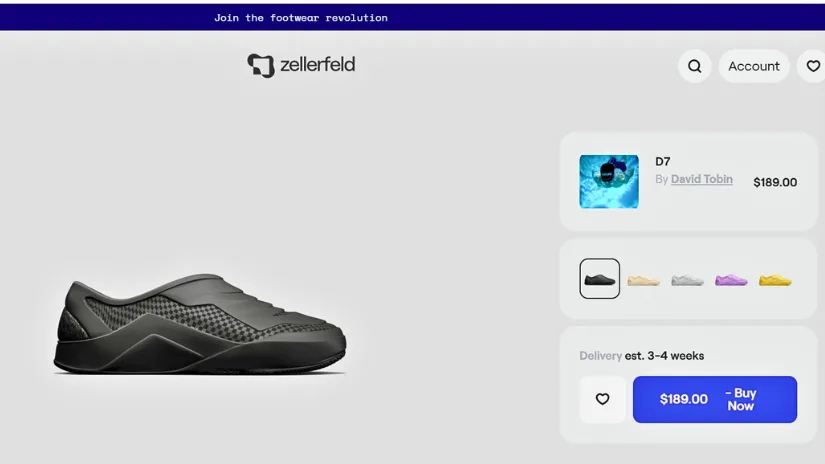
Price: $189.99 USD
Compare the Prices & Discounts:
Official Website
What makes their shoes particularly interesting is not only the manufacturing approach, but the business structure behind it. Designers and creators are reportedly granted up to 60 percent backend royalties per shoe sold rather than receiving a traditional affiliate commission. This shifts the relationship from promotion-based income to product ownership, giving creators long-term participation in the product’s success.
The brand has already attracted high-profile collaborations, including celebrities such as Justin Bieber. In one notable example, Bieber teamed up with Zellerfeld to create a fully 3D printed soccer-inspired sneaker for his SKYLRK brand, further pushing 3D printed footwear into mainstream culture and fashion discussion.
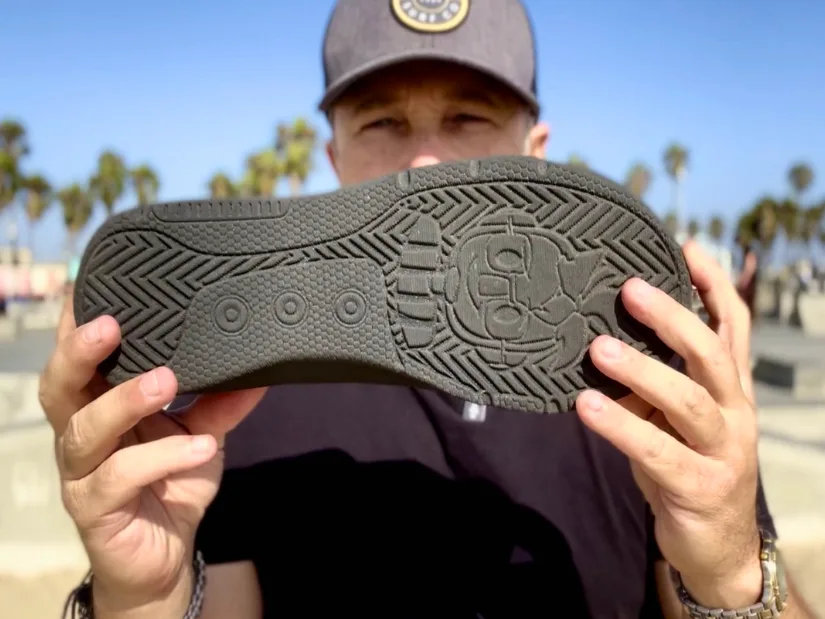
Photo: David Tobin
In the 3D printing world, David Tobin (Executive Producer at 3D Printing Nerd Channel) also surprised the community with the release of the JoelBot D7, a limited edition version of his original D7 shoes. The short 3DPrintingNerd’s video highlights a customized D7 sole design featuring a textured outsole with a distinctive JoelBot character pattern integrated directly into the tread. This personalized detail reinforces the creator-driven approach behind the collaboration and shows how fully 3D printed footwear allows branding and design elements to become part of the structure itself.
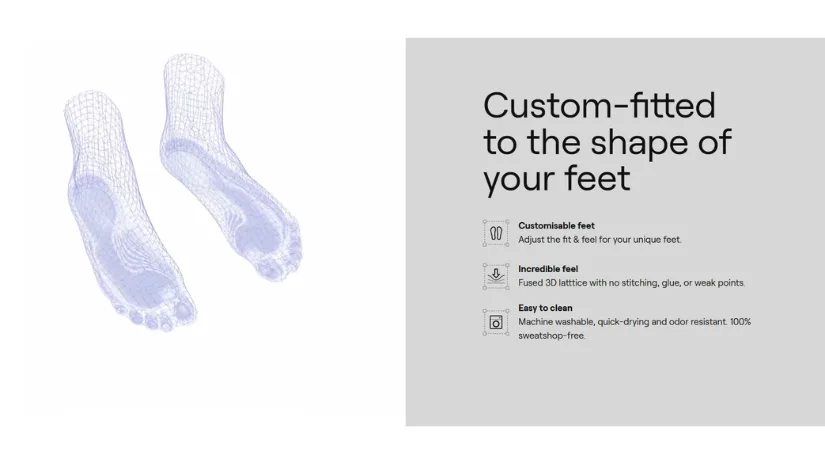
Foot scanning is becoming a key part of the 3D printed footwear workflow. Instead of relying solely on traditional sizing charts, some brands use browser-based scanning systems that allow customers to capture the shape of their feet using a smartphone camera. This digital input can then be used to adjust fit and structure before production, moving closer to true mass customization rather than standardized sizing.
PollyFab
Flux
Price: $119.99 – 199.99 USD
Compare the Prices & Discounts:
Official Website
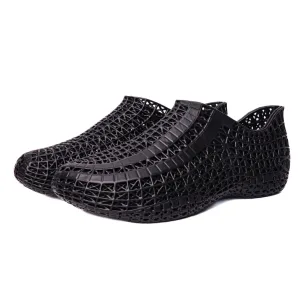
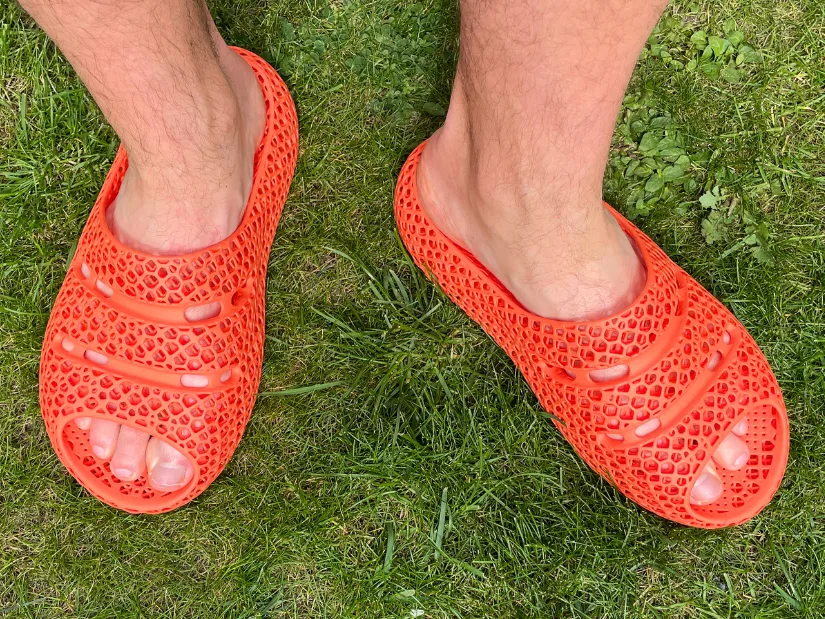
PollyFab’s shoes are made entirely through 3D printing, using a flexible lattice geometry that replaces the need for traditional soles, insoles, and stitching. The open mesh pattern allows air circulation and gives the shoes a springy, cushioned feel. Available in black, white and orange, they arrive neatly boxed with stuffed interiors to maintain shape.
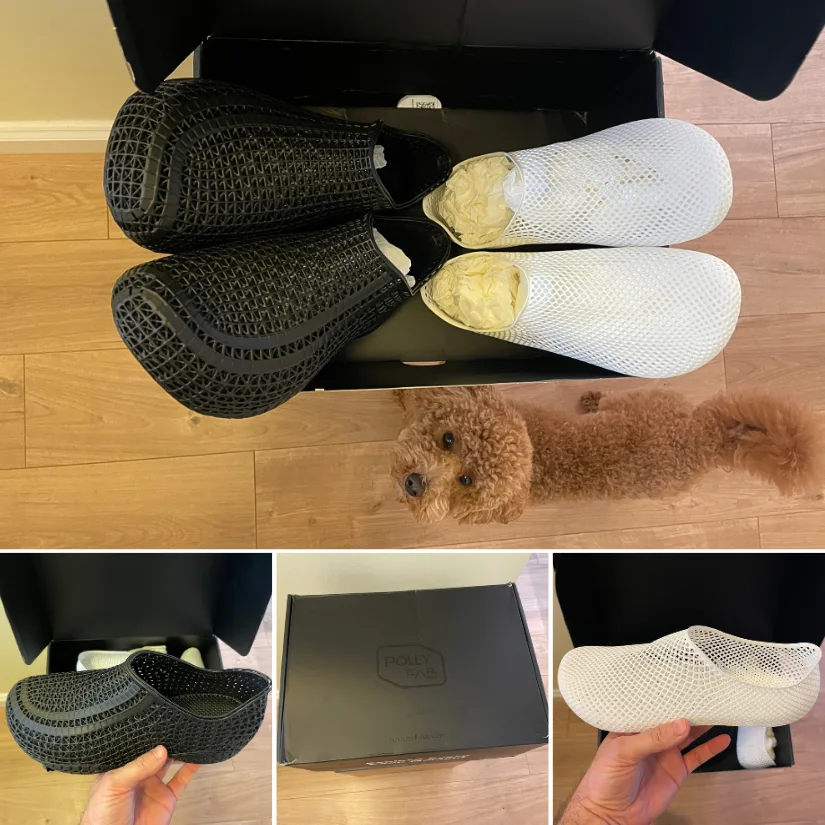
©3DWithUs – Photo: Max Funkner
PollyFab’s lattice shoes are produced through advanced additive manufacturing using a custom, bio-based elastomer called ELASTO 1000 BIO, designed for high elasticity, resilience, and long-lasting flexibility. This specially engineered material allows the lattice structure to bend, compress, and rebound with each step, giving the shoes a springy, adaptive feel that would be difficult to achieve with traditional materials.
In the Flux Short and Airpuff One Pro Short videos, I briefly showcase my testing in everyday situations, including visiting a trade show and taking the shoes for a walk in the park.
Read more – unboxing, testing, and other design examples:
PollyFab 3D Printed Shoes: Comfort, Design, and Durability Test by Max Funkner.
Adidas 4D and the “Lattice Midsole” Era
Adidas helped push 3D printed footwear into mainstream visibility with its 4D series developed together with Carbon. Today, a number of Adidas 4D derivatives are available for both men and women, combining traditional sneaker construction with a visually distinctive 3D printed lattice midsole. When I briefly checked current pricing in the US, some models were already available from around $100 with discounts applied.
©3DWithUs – Photo: Max Funkner
In the Adidas 4D approach, the lattice midsole is the 3D printed component, while the upper part of the shoe remains traditionally manufactured. This hybrid construction allowed brands to introduce additive manufacturing into existing footwear production workflows without fully redesigning the entire shoe around 3D printing.
This approach likely scaled first because it focuses on one of the most important functional areas of footwear: cushioning and energy return. The lattice structure also became a strong visual signature, helping consumers immediately recognize that the shoe contains a 3D printed element.
From my perspective, Adidas 4D played an important role in normalizing 3D printed footwear for mainstream audiences. At the same time, it still represents a hybrid product rather than a fully 3D printed shoe. While the lattice sole demonstrates the advantages of additive manufacturing, the upper remains tied to conventional production methods.
Carbon played a major role in this movement by developing the Digital Light Synthesis (DLS) technology used to manufacture the lattice midsoles. Their partnership with Adidas became one of the earliest large-scale examples of 3D printing entering commercial footwear production. Special thanks to Andrew Sink for the walkthrough and discussions at the Carbon booth during Formnext.
Fully FDM 3D Printed at Home – Challenges
Now and then on social media, it is possible to spot fully 3D printed shoes made from TPU using large volume desktop FDM 3D printers. I personally did not have the chance to print and wear a full pair yet, but I had a great opportunity to speak with people who successfully printed and tested such shoes in everyday conditions.
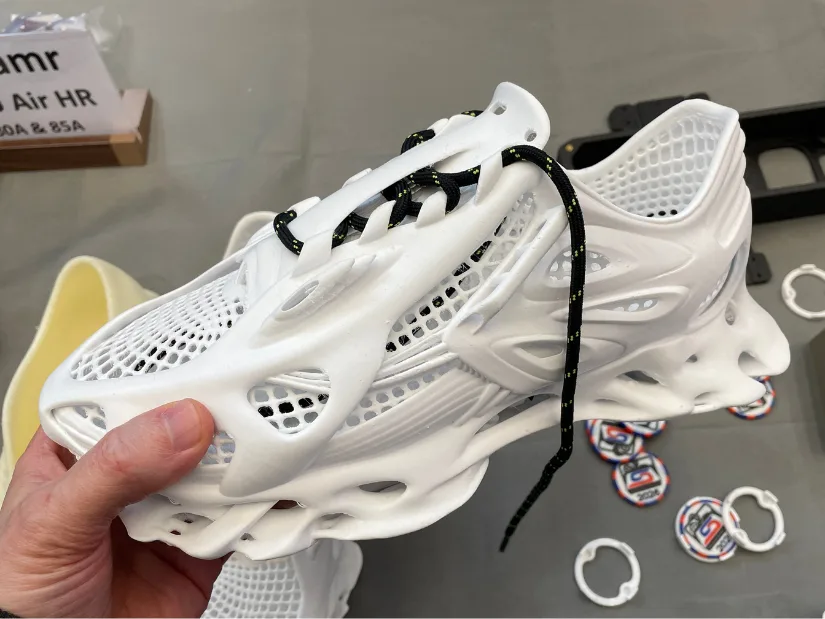
Featured Model: Whaleberry by Cloudberry via MakerWorld
©3DWithUs – Photo: Max Funkner
From those conversations, it became clear that while printing wearable footwear at home is absolutely possible, it still comes with challenges around sizing, print time, flexibility, durability, and long-term comfort. Material choice also plays a major role, with softer TPU blends behaving very differently from more rigid formulations.
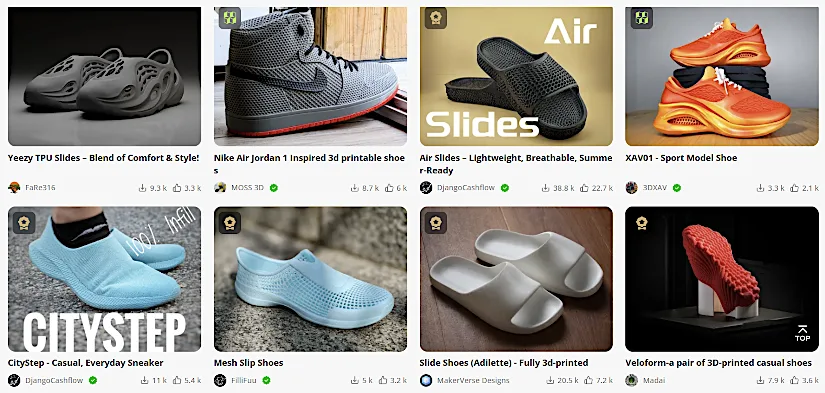
Screenshot – MakerWorld
Nevertheless, despite all these obstacles, fully 3D printed shoes continue gaining popularity within the maker community. More users are printing wearable footwear at home and sharing valuable feedback about comfort, durability, sizing, and material behavior. Collections of shoe models on MakerWorld keep growing with increasingly impressive and experimental designs. Use a quick ‘Shoes’ or ‘TPU Shoes’ in search.
Apart from the very popular Whaleberry design by Cloudberry shown in the image, I also liked the CityStep – Casual, Everyday Sneaker by DjangoCashflow. It is especially helpful to read user opinions and browse shared test prints in the profile and comment sections of these shoe models.
Comfort, Durability Testing
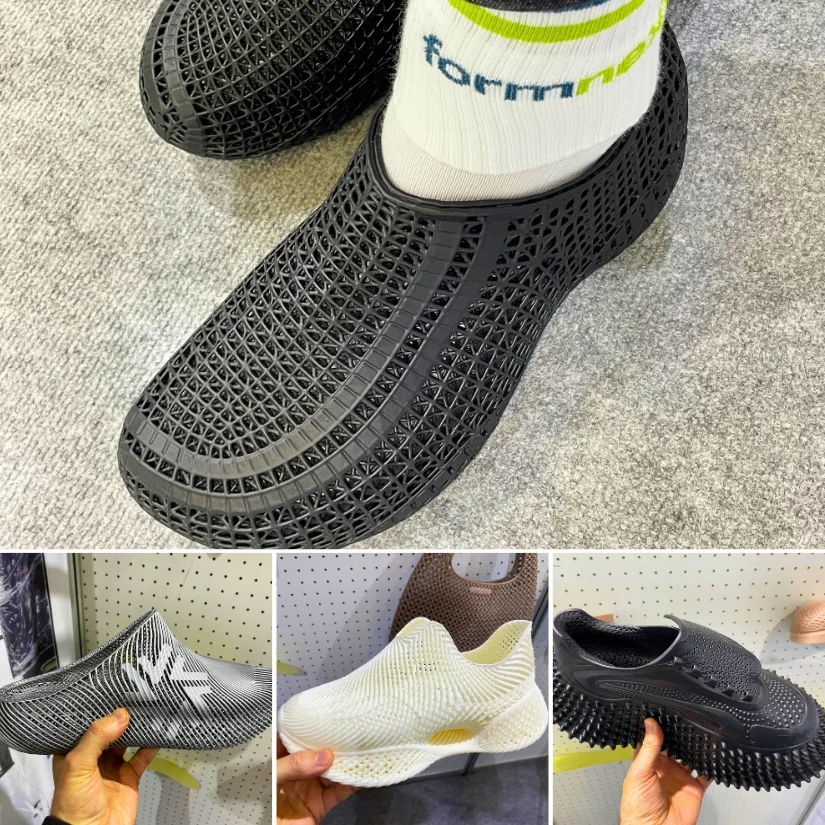
To test long-term comfort and durability, I wore the same pair of Flux shoes at the Formnext trade show in Frankfurt. Two full days of walking across multiple exhibition halls turned into an excellent field test. The shoes handled the event surprisingly well: no noticeable deformation, a good grip on polished floors, and consistent cushioning throughout. Honestly, I expected blisters; I got some when I was wearing standard shoes at events a few years ago, but this time it never happened.
©3DWithUs – Photo: Max Funkner
This is also where I tested them with Formnext-branded high socks. High socks are almost inevitable in winter in northern countries to keep the cold out.
I am not the only one who tested 3D Printed shoes on the trade flor. At 3d printing or Am related tradeshow it is a high chance to meet a both representative or even visitors who wear them – stop and talk about their shoes I am shure they will have insignfull stores about their 3D printed shoes.
I am not the only one who tested 3D printed shoes on the trade show floor. At 3D printing or additive manufacturing related trade shows, there is a high chance of meeting both representatives and visitors wearing them. Stop and ask about their shoes, I am sure they will have insightful stories and experiences to share about their 3D printed footwear.
Who Should Consider 3D Printed Shoes?
As 3D printed shoes become more accessible, I would not necessarily recommend buying a budget FDM or desktop resin 3D printer solely for printing footwear at home. Between printer cost, materials, maintenance, space requirements, print failures, and the experience needed to produce wearable results, it may currently be easier and more practical for many users to purchase an existing model in the around-$100 category.
At the same time, for makers who already own a larger-volume printer and enjoy experimenting with functional TPU prints, 3D printed footwear can become a very exciting direction to explore. Beyond personal projects, the growing interest around customized footwear and printable shoe models may even open opportunities for small-scale business ideas and local customization services in the future.
Have questions? Feel free to ask in the comment section below.
For a wider discussion or to share your own 3D printed shoes experience, join us in the forum:
Final Verdict: Are 3D Printed Shoes Ready?
3D printed shoes are no longer just futuristic concepts. From mainstream lattice midsoles to fully 3D printed footwear and home TPU experiments, the technology is already becoming part of real everyday use. While the space still feels early in some areas around fit, durability, and long-term comfort, the progress is happening fast. After testing multiple pairs and speaking with people actively wearing them, I genuinely believe 3D printed footwear is moving in the right direction and will continue evolving rapidly over the next few years.
Back to top ↑