This guide brings together our hands-on experience with eSUN filament across a growing range of 3DWithUs projects. From PLA and PETG to TPU and ABS, we are combining new tests with earlier print examples from our reviews and projects to show how these materials perform.
Table of Contents (Jump to a Section)
About eSUN
Founded in 2002, Shenzhen Esun Industrial Co., Ltd. is the company behind the eSUN brand and has more than 20 years of experience in polymer materials. Its 3D printing portfolio now covers a broad range of FDM filaments, photopolymer resins and SLS powders, with products sold in more than 100 countries and regions. For FDM users, the range includes familiar materials such as PLA, PETG, ABS and TPU alongside high-speed, engineering and specialty formulations.
For this guide, our focus is specifically on eSUN’s FDM filament range and the materials we have tested across different projects. Some examples come from previous printer reviews and contributor testing, while others are from the newer batch supplied directly by eSUN. Bringing them together in one place should make it easier to compare how different eSUN materials perform across printers, applications and print projects.
eSUN PLA and Test Examples
eSUN PLA is available in several variations, including Basic PLA, PLA+, PLA-HS, PLA Matte, and PLA Refill. PLA+ is generally tuned for improved toughness and strength, PLA-HS for faster printing, while PLA Matte focuses on a smooth, low-gloss surface finish. PLA Refill is supplied without a disposable spool for use with a compatible reusable spool.
Compare the Prices & Bundles:
Official Store | Amazon | AliExpress
eSUN PLA – Two-Color HueForge Wall Art
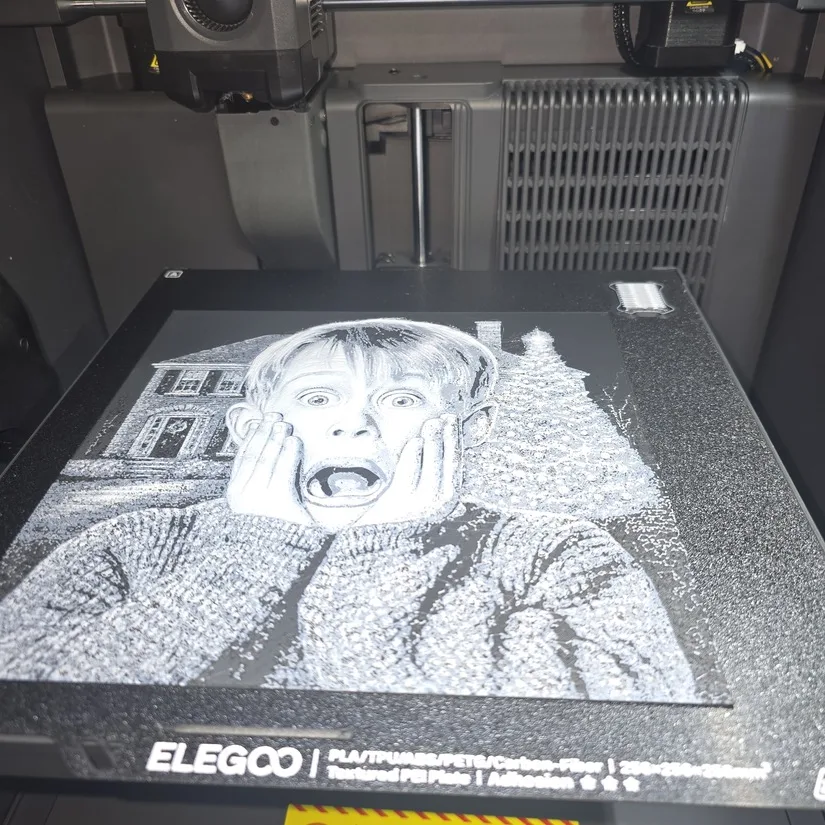
During Phil Macey’s Elegoo Centauri Carbon 2 Combo hands-on testing, he used eSUN Black PLA and eSUN White PLA for a two-color HueForge wall-art print based on a Home Alone design. The model occupied roughly 80% of the build plate and was printed at a 0.08 mm layer height with 100% infill, taking around six hours to complete. The layered color transitions between the black and white filament produced a convincing grey-scale effect across the image.
©3DWithUs – Print and Photo: Phil Macey
The finished print became one of Phil’s favorite test models from the Centauri Carbon 2 review. It also makes a useful example of how standard eSUN PLA can work well for detailed decorative projects where controlled layer changes, clean contrast and consistent extrusion matter more than raw print speed.
eSUN PETG and Test Examples
Same as with PLA, eSUN PETG is available in several variations, including Basic PETG, PETG+, PETG-HS, and PETG Refill. The “+” designation generally indicates an enhanced formulation of the standard material, typically tuned for improved toughness, strength, or printing performance, while “HS” refers to a high-speed version designed for faster printing. PETG Refill is supplied without a disposable spool, allowing users to load the filament onto a compatible reusable spool and reduce packaging waste.
Compare the Prices & Bundles:
Official Store | Amazon | AliExpress
eSUN PETG – Honeycomb Storage Wall
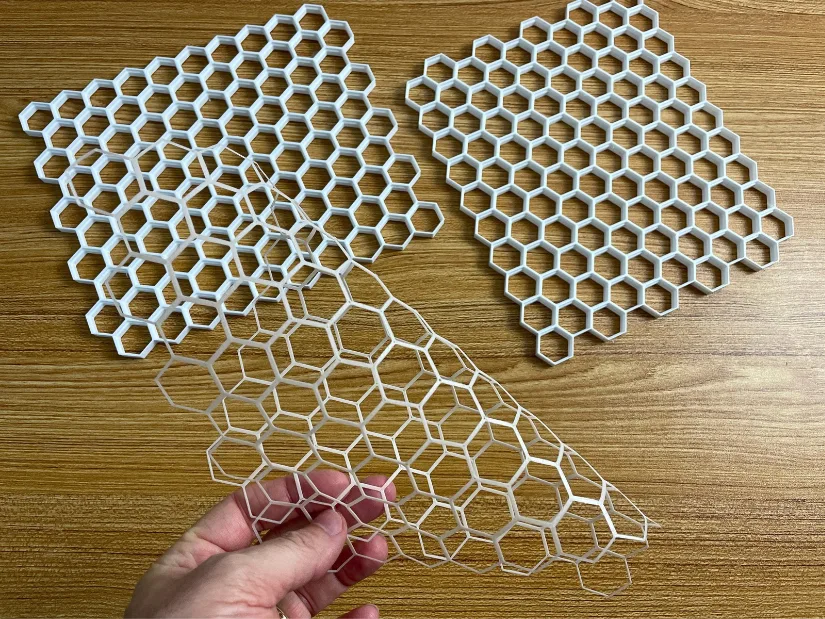
eSUN PETG is a very good fit for Honeycomb Storage Wall projects, where toughness and resistance to cracking matter more than the easy printability of PLA. In his detailed Honeycomb Storage Wall guide, Dimand Márton recommends PETG for the main wall sections, fasteners and load-bearing holders because PLA can be more brittle around clips, screw holes and mounting points. For my own testing, I used white eSUN PETG to print HSW wall sections, continuing the same practical material choice for a modular wall that is intended to be assembled, loaded, and expanded over time.
©3DWithUs – Print and Photo: Max Funkner
My next aim is to speed up the process by using the HSW Stacked Print design by 3D Design HK, which allows several wall sections to be printed in one job. So far, I have successfully completed a stack of three. The thin separating layer visible in the photo is PLA: using PLA between PETG layers is a useful trick for stackable prints because the two materials do not bond strongly to each other, making the finished sections easier to separate. The same principle is also commonly used when PLA and PETG are paired as support-interface materials.
eSUN PETG – Tensegrity Sandal by 3DPrintBunny
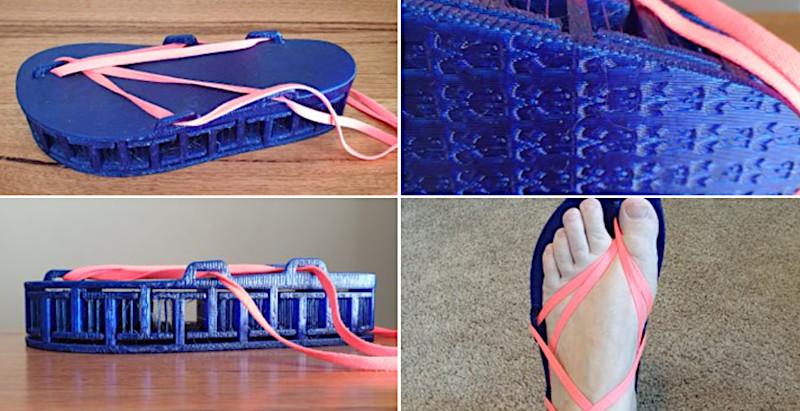
In our Tensegrity Models guide, 3D printing artist and designer Natalie Cheesmond, also known as 3DPrintBunny, used eSUN Transparent Blue PETG for an experimental tensegrity sandal. The design clusters multiple tensegrity structures together, increasing the overall strength through a network of printed tension elements. The result is a fully 3D printed sandal structure strong enough to support the weight of a person.
(Image: Natalie Cheesmond)
This project is a good example of PETG being used for more than conventional brackets or mechanical parts. Its combination of strength and some flexibility suited the unusual load-bearing tensegrity design, while the transparent blue filament also helped emphasize the structure visually. It remains one of the more experimental eSUN PETG examples featured on 3DWithUs.
eSUN TPU and Test Examples
There are no typical Refill or HS versions for TPU. Refill systems are less practical for soft, flexible filament, while high-speed printing is limited mainly by TPU’s feeding behavior and elasticity.
Compare the Prices & Bundles:
Official Store | Amazon | AliExpress
eSUN TPU 95A – 3D Printed Trainers on the Flashforge Creator 5
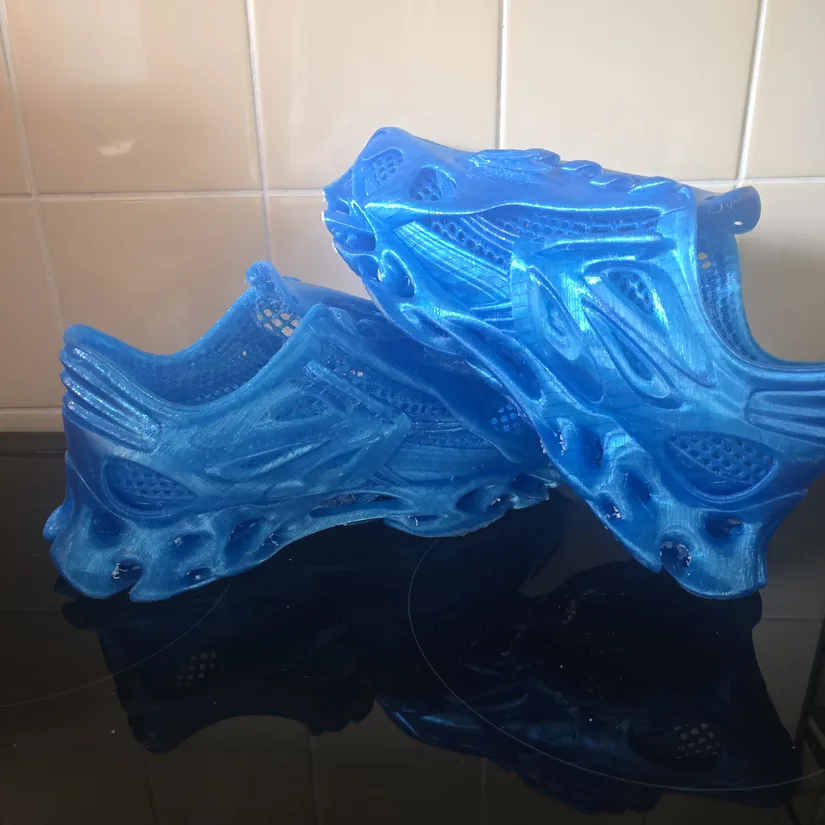
One of our more demanding eSUN TPU 95A tests came during our Flashforge Creator 5 hands-on review. Phil Macey used blue eSUN TPU 95A to print a pair of full-size trainers, with Snapmaker Breakaway filament used for the supports. Because of the required shoe size and the Creator 5 build volume, each trainer had to be printed separately. Each shoe took roughly 3.5 days to complete at a 0.2 mm layer height, making this a useful long-duration test of both the material and the printer.
©3DWithUs – Photo: Phil Macey
Both shoes completed successfully, with the TPU printing reliably throughout around seven days of total print time. The finished trainers looked impressive, although comfort was limited by the material choice and the support setup used for this particular project. As a practical test, however, it showed that eSUN TPU 95A can handle large, flexible prints that go well beyond small calibration models.
eSUN ABS and Test Examples
eSUN ABS is available in Basic ABS, ABS+ and ABS-HS versions. ABS+ is generally tuned for improved toughness and printability, while ABS-HS is designed for higher-speed printing.
Compare the Prices & Bundles:
Official Store | Amazon | AliExpress
To feature eSUN ABS in this guide, we printed several functional HSW hooks designed by Dimand Márton for our ever-growing Honeycomb Storage Wall. It is a practical use case for ABS, where toughness and durability matter more than appearance alone. We will add the finished print images and more observations from this test shortly.
eSUN at Tradeshows
As 3DWithUs, we have been seeing eSUN at major 3D printing and additive manufacturing tradeshows since 2016. Over the years, the brand has maintained a regular presence at industry events, using these shows to present new materials, demonstrate filament applications, meet users and partners, and stay visible within the wider 3D printing community.
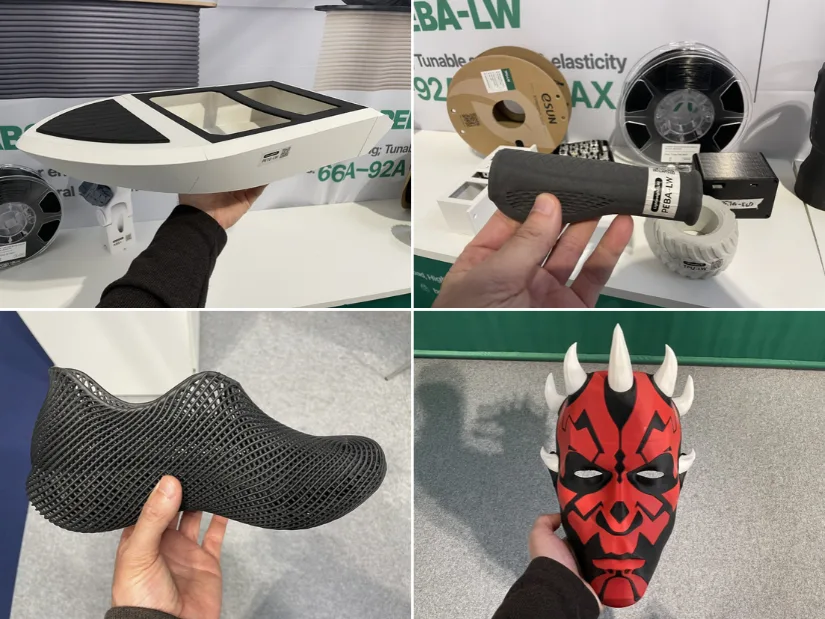
Photo: Max Funkner
These repeated appearances also give useful context to eSUN’s long-term position in the 3D printing market. Rather than looking at the brand through a single product launch or collaboration, our tradeshow coverage shows how its filament range, applications and 3D printed showcase projects have evolved over the years.
Have questions? Feel free to ask in the comment section below.
For a wider discussion or to share your own eSUN prints, join us in the forum:
Conclusion
eSUN has built a broad filament range around familiar materials such as PLA, PETG, TPU and ABS, with additional formulations aimed at higher speed, improved toughness, different surface finishes and more specialized applications. Across our own hands-on projects and previous 3DWithUs reviews, these materials have already been used for everything from decorative prints and flexible footwear to functional storage systems and larger engineering-style parts.
This guide is intended to remain a growing reference rather than a one-time review. As we continue testing the latest eSUN filaments, adding new print projects and documenting the brand at tradeshows, we will update the sections above with more examples, settings and practical observations. That should make it easier to see not only what each filament is designed for, but how it performs in 3D printing projects.