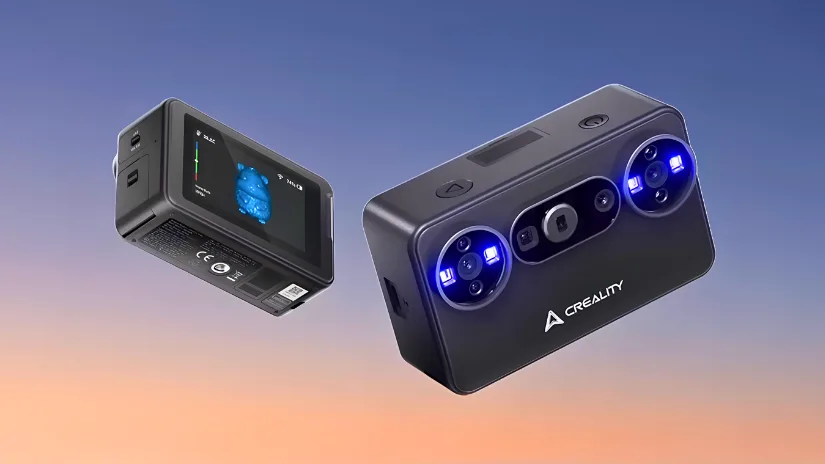
Creality continues to expand its 3D scanning lineup with devices aimed at very different use cases, from the compact Creality Pika to the more advanced standalone Sermoon P1. In this guide, we track the latest Creality 3D scanners, highlight their key features and specifications, and link to our hands-on reviews where available. The Pika will be the next model we test, while the Sermoon P1 and CR-Scan Ferret series have already been evaluated in real-world scanning workflows.
Table of Contents
Creality Pika 3D Scanner Overview NEW
Price: $699
Compare the Prices & Bundles:
Official Website | Amazon
The Creality Pika takes the lead position in our regularly updated Creality 3D scanner guide. We will be receiving the scanner for hands-on testing, so this section will initially cover the main features and positioning of the Pika, followed by our own scanning tests and practical observations once the unit arrives.
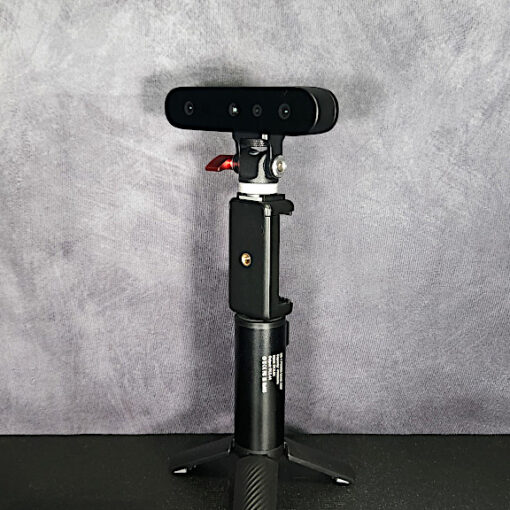
The Creality Pika stands out first of all for its unusually compact design. At just 100 × 60 × 35 mm and 260 g including the batteries, it is small enough to fit in the palm of a hand and should be easy to carry between scanning jobs. Despite its size, Pika combines 7 parallel blue laser lines for higher-detail scanning with NIR structured light for larger objects and color capture. Creality rates the blue-laser mode for accuracy of up to 0.03 mm and scanning speeds up to 110 FPS when connected to a PC.

Another useful feature is the built-in 3-inch touchscreen, which provides direct access to scanning controls, although the scanner still needs to be connected to a phone, tablet or computer for processing. Pika also supports marker-free laser scanning for suitable objects, Wi-Fi connectivity and two quick-swap 3,350 mAh batteries. Creality is putting particular emphasis on software-assisted workflows as well, including AI retexturing, AI hole filling and AI Body Completion. For outdoor or brightly lit environments, the blue-laser mode is specified to operate at illumination levels up to 110,000 lux, while the filtered NIR mode is rated up to 80,000 lux.
Creality PIKA Specifications
Scanning modes: 7 parallel blue laser lines and NIR structured light
Accuracy: Up to 0.03 mm in blue laser mode; up to 0.1 mm in NIR mode
3D resolution: 0.1–2 mm in blue laser mode; 0.15–2 mm in NIR mode
Scanning speed: Up to 110 FPS on PC in blue laser mode; up to 30 FPS in NIR mode
Minimum scan volume: 10 × 10 × 10 mm in blue laser mode; 50 × 50 × 50 mm in NIR mode
Working distance: 160–400 mm in blue laser mode; 140–1,000 mm in NIR mode
Tracking/alignment: Marker, global marker and marker-free modes, plus geometry and texture alignment
Color scanning: Yes
Display and connectivity: 3-inch touchscreen, Wi-Fi 6 and USB 3.0 Type-C
Weight: 260 g including batteries
Check the full list of specifications and list of included accessories via Official Website
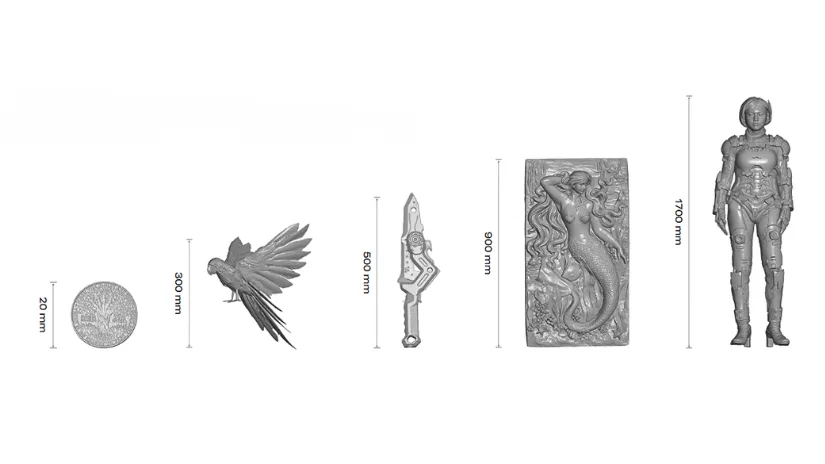
Creality also showcases an impressive range of scanning targets in its Pika demo media, from very small objects around 20 mm across to decorative models, medium-sized parts and full-body scans up to around 1.7 m tall.
Official Creality Pika 3D scanner video.
In Creality’s launch video above, the company also demonstrates how the Pika can be used outdoors on a bright day with the help of an additional filter lens, extending its scanning capability to more challenging lighting conditions.
Creality Sermoon P1 NEW
Price: $2,999 – $3,299
Compare the Prices & Bundles:
Official Website | Amazon
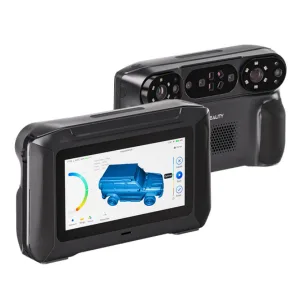
The Creality Sermoon P1 is one of the Creality scanners we have already tested extensively. It combines multiple scanning modes with standalone and computer-connected operation, making it suitable for a wider range of objects and scanning workflows.
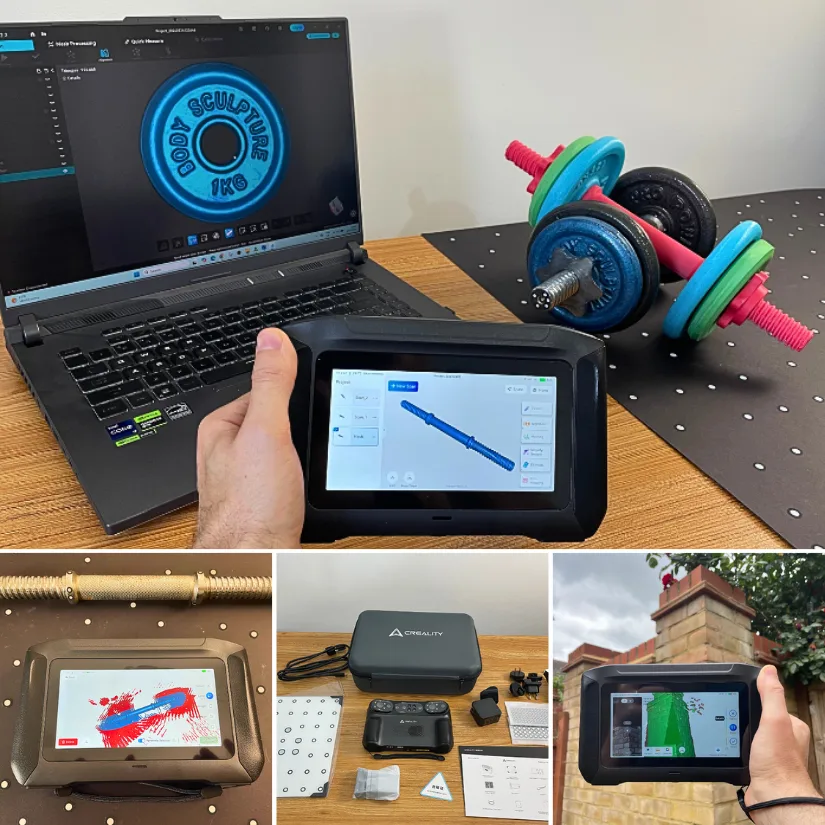
©3DWithUs – Scan, Print and Photo: Max Funkner
After several weeks of testing, the Creality Sermoon P1 proved to be a capable and well-rounded standalone 3D scanner. I tested every major scanning mode, including Cross, Single, and Parallel Blue Laser modes, Infrared Structured Light, as well as standalone, wired PC, and wireless PC workflows. Projects ranged from reverse engineering metal dumbbell components and creating functional 3D printed replicas to outdoor scanning, giving me a good understanding of where the scanner performs best. by Max Funkner
Our dedicated Creality Sermoon P1 hands-on review covers setup, scanning modes, marker-based workflows and several practical scanning tests.
Creality CR-Scan Ferret Pro – Hands-On Review
Price: $359-449
Compare the Prices & Bundles:
Amazon | AliExpress | Official Website
The Creality CR-Scan Ferret Pro expanded the Ferret range with improvements aimed at making portable 3D scanning more practical. Its compact format makes it particularly interesting for users looking for an accessible handheld scanner without moving into larger professional systems.
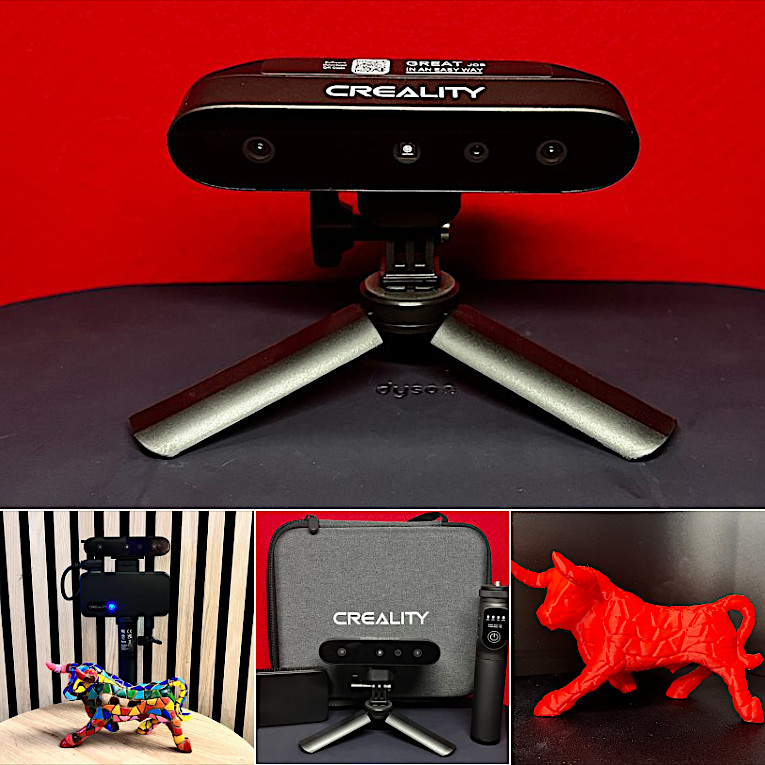
©3DWithUs – Photo and Print: Richard Hirst
In terms of affordability, I was pleasantly surprised by the price range of the Creality Ferret Pro. It offers excellent value for the quality it delivers. Investing in this product ensures that you obtain a reliable and accurate 3D scanning solution without breaking the bank. In conclusion, my experience with the Creality Ferret Pro has been positive, and it was fun to use and learn what a 3D scanner can do. by Richard Hirst
See our Creality CR-Scan Ferret Pro hands-on review and 3D scanner testing for our experience with the scanner and real-world test objects.
Creality CR-Scan Ferret – Hands-On Review
The original Creality CR-Scan Ferret helped establish Creality’s more compact and affordable generation of handheld 3D scanners. We tested the scanner across several objects to see where this lightweight approach works well and where more advanced scanning hardware becomes useful.
Our complete Creality CR-Scan Ferret hands-on review includes practical scanning tests, workflow observations and examples of captured models.
Creality Ecosystem: 3D Printers, Laser Cutters and Filament Recycling
3D scanners are now only one part of the wider Creality ecosystem. The company continues to develop hardware across 3D printing, scanning, laser cutting and material recycling, creating increasingly connected workflows from capturing or designing an object through to manufacturing it.
For the latest machines and developments on the additive manufacturing side, see our regularly updated Creality New 3D Printers guide. It tracks new Creality 3D printer launches and links to our hands-on reviews where available.
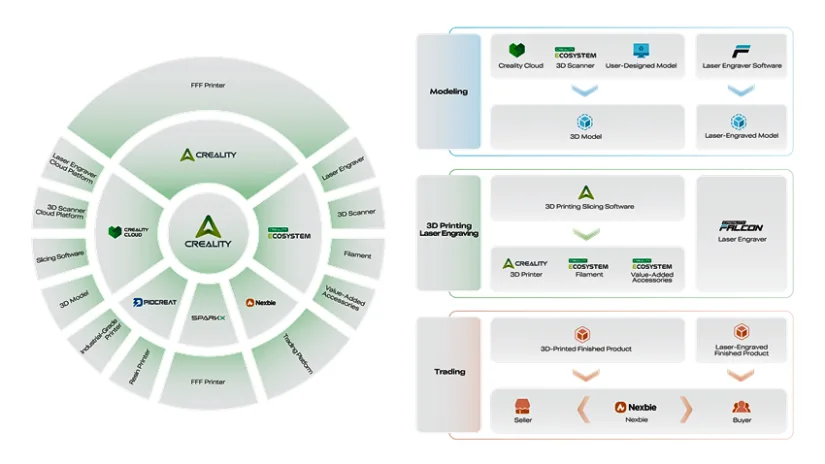
Creality has also expanded substantially into laser cutting and engraving. We have tested several machines from the Falcon range, including the Creality Falcon2 22W laser cutter and engraver, where we covered practical cutting and engraving settings across different materials.
Another interesting part of the ecosystem is material reuse. Creality has demonstrated a filament maker and shredder recycling system designed around turning failed prints and plastic waste back into usable filament. Together, these products show how Creality is moving beyond individual machines toward a broader digital fabrication ecosystem.
About Creality
Founded in 2014, Creality is a leading manufacturer of 3D printers, 3D scanners, laser cutters, and other equipment. The company became widely known through its Ender series of affordable FDM 3D printers and has since expanded into enclosed CoreXY systems, resin printing, handheld and professional 3D scanning, laser engraving and material recycling.
This guide will be updated as new Creality 3D scanners are announced and as additional hands-on testing becomes available on 3DWithUs.